










Breaking News
 Massachusetts Dems Advance Bill to LIMIT How Far You Can DRIVE In Your Own Car
 Greater Israel Wrecked the Peace Talks
 Watch: Morano's closing keynote speech to the 16th International Conference on Climate Change...
 What Is Fueling Unrest Across the EU?
Top Tech News
 Energy storage breakthrough traps sunlight in a molecule
 Steel rebar may have met its match – in the form of wavy plastic
 Video: Semicircular wings give Cyclone VTOL a different kind of lift
 After 20 Years, Wave Energy Finally Works
 FCC Set To "Supercharge" Starlink Space Internet With "Seven-Fold More Capacity"
 'World's First' Humanoid Robot For Real Household Chores Launched With 16-Hour Battery
 XAI Training 10 Trillion Parameter Model – Likely Out in Mid 2026
 The $7 Powder That Beats Your $5,000 AC Unit!
 Private credit is now a $3 trillion asset class and investors are receiving 45 cents on the dollar
 Converting Diesel Vehicles to Run on Waste Vegetable Oil, by Polar Bear



What Is Fueling Unrest Across the EU?
This has resulted from the disruption of the Strait of Hormuz, a critical route for global energy shipments. Oil prices surged above $120 per barrel during the escalation, and while crude fell below the $100 mark after a two-week US-Iran ceasefire was announced on April 7, it remains well above the $70 level before the war. Prices have remained volatile amid uncertainty over the truce and continued disruption to shipping through the strait.
Diesel and kerosene have emerged as the central pressure points in the crisis. Europe's benchmark diesel and jet fuel prices have risen above $200 per barrel equivalent from below $100 in January, according to Bloomberg. Jet fuel prices have also surged since the start of the conflict in late February, according to industry data cited by multiple outlets.
Why has diesel become more expensive than gasoline?
The European market has shifted toward higher diesel consumption following decades of tax policies that lowered diesel taxes compared to gasoline.
The EU's refining system produces a different mix of fuels than the market consumes. A barrel of crude oil typically yields about 40-50% gasoline, but only around 30–40% diesel and jet fuel combined, with the rest made up of heavier products.
This mismatch has left the bloc structurally short of diesel. The region is a major net exporter of gasoline but relies on imports for a significant share of its diesel and jet fuel.
Diesel has traded above gasoline prices at the pump in several EU countries.
Rising wholesale costs have fed through to consumers. Diesel prices at the pump have exceeded €2 per liter in multiple countries, according to national data and media reports — equivalent to roughly $8.80–$10.50 per US gallon, compared with about $5.60 per gallon in the US. Governments in Italy, Portugal, Slovenia, Hungary, Spain, Poland, and Ireland have introduced tax cuts and other measures to limit the impact of rising fuel costs.
Why are farmers and truckers protesting?
Rising diesel prices are hitting sectors most dependent on the fuel, particularly agriculture and road freight. The EU's transport sector is facing a "fast-moving diesel shock," according to logistics platform Logifie.
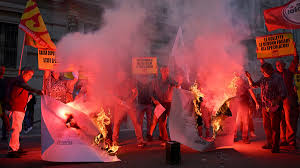
Ireland has become the most visible flashpoint of the crisis. Fuel protests have spread nationwide since this past Tuesday, led by farmers, truckers and transport workers, disrupting supply chains and transport networks, according to local media.
Blockades have strained fuel distribution, with queues forming at petrol stations with some running dry amid panic buying. On Thursday, the government called in the army to clear the blockades.
During a protest march in Dublin on Friday, demonstrators carried a coffin with "RIP Ireland" written on it.