










Breaking News
 5 years building private village out of free dirt for family of 6
 Massachusetts Dems Advance Bill to LIMIT How Far You Can DRIVE In Your Own Car
 Greater Israel Wrecked the Peace Talks
 Watch: Morano's closing keynote speech to the 16th International Conference on Climate Change...
Top Tech News
 Energy storage breakthrough traps sunlight in a molecule
 Steel rebar may have met its match – in the form of wavy plastic
 Video: Semicircular wings give Cyclone VTOL a different kind of lift
 After 20 Years, Wave Energy Finally Works
 FCC Set To "Supercharge" Starlink Space Internet With "Seven-Fold More Capacity"
 'World's First' Humanoid Robot For Real Household Chores Launched With 16-Hour Battery
 XAI Training 10 Trillion Parameter Model – Likely Out in Mid 2026
 The $7 Powder That Beats Your $5,000 AC Unit!
 Private credit is now a $3 trillion asset class and investors are receiving 45 cents on the dollar
 Converting Diesel Vehicles to Run on Waste Vegetable Oil, by Polar Bear



5 years building private village out of free dirt for family of 6
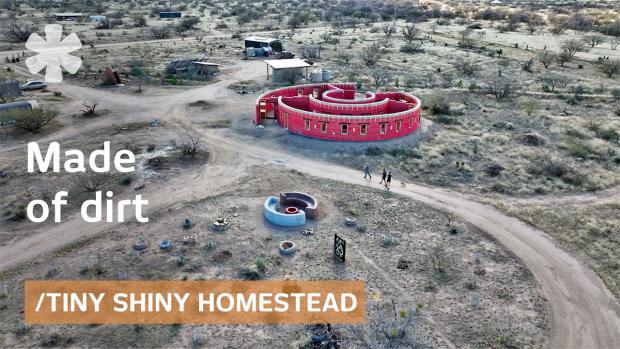
After 5 years of traveling full-time in a tiny home, this family of 6 realized they couldn't go back to a "normal" life - so they bought 11 acres of raw desert in Cochise County, Arizona and started building their own off-grid village from the ground up… using the dirt beneath their feet.
Jonathan and Ashley Longnecker ?@TinyShinyHome? and their 4 kids are creating a natural building homestead using earthbags, hyperadobe, and superadobe techniques—one structure at a time. What's emerging is less a single house and more a small, self-built village.
So far, they've built a hyperadobe bedroom, bathroom, and chicken coop, a superadobe sleeping space, and an outdoor earthbag shower. They've added a goat milking and kidding barn made from shipping containers, a container guest room, and a renovated 1972 Airstream Sovereign that serves as both their original tiny home and a bunkhouse for the kids.
Around these structures, they're developing the systems that make off-grid life work: solar power, water systems, a solar pump house, and permaculture-inspired design adapted to the desert.
Now they're working on their most ambitious project yet: what may become the world's largest hyperadobe home—a 5,000-square-foot round house built from earth-filled bags. Along the way, they've refined their own approach to hyperadobe, developing a faster, more efficient building method that Jonathan describes as "almost like 3D printing" with earth.
They homeschool their kids, build nearly everything themselves, and share the process as they go—testing ideas, refining techniques, and showing what it really takes to create an off-grid life from scratch, centered on family, creativity, and self-sufficiency.