










Breaking News
 Researchers Turn Car Battery Acid and Plastic Waste into Clean Hydrogen and New Plastic
 Stop Guessing: When to Pressure Can vs. Water Bath Can
 What Do Authoritarians Fear Most? People Who Stick Up for Each Other.
 12V 460Ah Epoch "V2-T" Marine Rated Battery! Holy Cow..
Top Tech News
 The Most Dangerous Race on Earth Isn't Nuclear - It's Quantum.
 This Plasma Stove Cooks Hotter Than The Sun
 Energy storage breakthrough traps sunlight in a molecule
 Steel rebar may have met its match – in the form of wavy plastic
 Video: Semicircular wings give Cyclone VTOL a different kind of lift
 After 20 Years, Wave Energy Finally Works
 FCC Set To "Supercharge" Starlink Space Internet With "Seven-Fold More Capacity"
 'World's First' Humanoid Robot For Real Household Chores Launched With 16-Hour Battery
 XAI Training 10 Trillion Parameter Model – Likely Out in Mid 2026
 The $7 Powder That Beats Your $5,000 AC Unit!



The billionaire space race heats up! Elon Musk and Jeff Bezos's lunar landers will go...
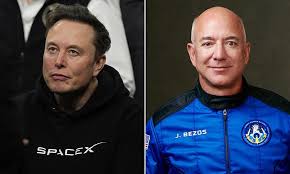
The billionaire space race is entering a tense new stretch, as Elon Musk and Jeff Bezos vie to win a coveted moon landing contract.
Musk's SpaceX and Bezos' Blue Origin could go head–to–head in a 250–mile–high contest to secure their spot in NASA's first lunar landing in 50 years.
Both companies have been contracted to develop lunar landers, and NASA now plans to put the two in direct competition during next year's Artemis III mission.
Whichever lander impresses NASA's bosses the most will secure a spot in history as the first private company to put humans on the moon.
Following a shakeup of the Artemis timeline, Artemis III will not be a moon landing as previously planned, but a low–Earth orbit test of NASA's landing technology.
The mission will practice docking the Orion crew capsule, which will carry astronauts to the moon's orbit, with the lander that will take them down to the lunar surface during the 2028 Artemis IV mission.
SpaceX had originally been contracted to provide its Starship Human Landing System (HLS) for the first landing, but ongoing delays at Musk's space company prompted NASA to invite other bidders in October last year.
The space agency now says that 'one or both' of the landers will be involved in Artemis III, putting Musk and Bezos in a straight race for the moon.
Although SpaceX and Blue Origin both had contracts from NASA to develop a lander, Bezos' Blue Moon lander was originally meant to serve later Artemis missions.
However, NASA now says it is ready to test whichever landers are ready when Artemis III comes around in 2027.
The spacecraft will be tested for life support functions, propulsion, and communication systems before a trial docking with Orion, which NASA says will 'put the landers through their paces'.
SpaceX won a $2.89 billion contract to develop Starship, an enormous reusable, methane and oxygen–powered lander.
The craft is designed to land vertically, much like SpaceX's reusable booster rockets, before lowering the crew to the ground with a 'space elevator'.
During Artemis IV, if selected, Starship will carry only four astronauts, but it has the potential to carry a crew of 100 and up to 200 tonnes of cargo.
Blue Moon, on the other hand, is more similar to the style of lander used during the Apollo moon missions.
The craft is powered by a mix of liquid hydrogen and oxygen and would be carried into space on Blue Origin's New Glenn rocket.