










Breaking News
 Brace yourself for a SUPER El Niño: Likelihood of unusual climate pattern skyrockets...
 Researchers reconstruct 42 missing pages from a major early Christian manuscript...
 Russian scientists 'are developing the world's first drug to delay ageing' months after
 Woke hypocrites rage at NYC's socialist mayor for moving homeless into famously liberal...
Top Tech News
 Researchers Turn Car Battery Acid and Plastic Waste into Clean Hydrogen and New Plastic
 'Spin-flip' system pushes solar cell energy conversion efficiency past 100%
 A Startup Has Been Quietly Pitching Cloned Human Bodies to Transfer Your Brain Into
 DEYE 215kWh LiFePO4 + 125,000W Inverter + 200,000W MPPT = Run A Factory Offgrid!!
 China's Unitree Unveils Robot With "Human-Like Physique" That Can Outrun Most People
 This $200 Black Shaft Air Conditions Your Home For Free Forever -- Why Is It Banned in the U.S.?
 Engineers have developed a material capable of self-repairing more than 1,000 times,...
 They bypassed the eye entirely.
 The Most Dangerous Race on Earth Isn't Nuclear - It's Quantum.
 This Plasma Stove Cooks Hotter Than The Sun


Researchers reconstruct 42 missing pages from a major early Christian manuscript...
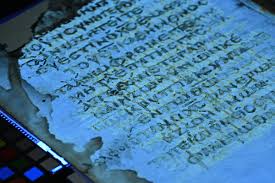
Experts have recovered 42 lost pages from a major early Christian manuscript, heralding a 'breakthrough' for understanding ancient scripture.
Scientists successfully reconstructed passages from Codex H – one of the world's most important early New Testament scripts.
The text, a 6th century copy of the Letter of St Paul, was lost to history when it was disassembled at the Great Lavra Monastery on Mount Athos in Greece in the 13th century.
Its pages were re–inked and reused as binding material and flyleaves for multiple other manuscripts.
Today, the surviving fragments are scattered across libraries in Italy, Greece, Russia, Ukraine and France.
Using advanced imaging techniques, an international team of academics have now been able to digitally reconstruct the missing pages – revealing text unseen for centuries.
The findings shed new light on ancient scribal habits and early biblical structures, providing unique insight about how people interacted with their sacred texts.
'Given that Codex H is such an important witness to our understanding of Christian scripture, to have discovered any new evidence – let alone this quantity – of what it originally looked like is nothing short of monumental,' Professor Garrick Allen, from the University of Glasgow, said.
Paul's letters, also known as Pauline epistles, are a group of texts in the New Testament traditionally attributed to Paul the Apostle and are the earliest written explanations of Christian theology.
These letters were written in the 1st century and sent to early Christian communities and individuals, explaining Christian beliefs and giving practical advice to churches.
Codex H, a 6th century handwritten book, contains a collection of these letters and shows how they were being used centuries later.
The codex was later taken apart and reused in other books, with pages scattered across multiple countries.
The researchers explained their breakthrough came from an important starting point – the knowledge that at one point, the manuscript was re–inked.
This describes the process of a scribe tracing over the original, fading ink with new ink to preserve the text.
'The chemicals in the new ink caused "offset" damage to facing pages,' Professor Allen explained.
'They essentially creating a mirror image of the text on the opposite leaf – sometimes leaving traces several pages deep, barely visible to the naked eye but very clear with latest imaging techniques.'