










Breaking News
 The Real Reason A 3rd Assassin Just Tried to Kill Trump - And Who Hired Him
 The Future of Home Gardening? I Found It in Texas!
 Why The Debt Cannot Be Ignored!
 Defenses Against Oligarchs' Aggression
Top Tech News
 Researcher wins 1 bitcoin bounty for 'largest quantum attack' on underlying tech
 Interceptor-Drone Arms-Race Emerges
 A startup called Inversion has introduced Arc, a space-based vehicle...
 Mining companies are using cosmic rays to find critical minerals
 They regrew a severed nerve - by shortening a bone.
 New Robot Ants Work Like Real Insects To Build And Dismantle On Their Own
 Russian scientists 'are developing the world's first drug to delay ageing' months after
 Sam Altman's World ID Expands Biometric Identity Checks
 China Tests Directed Energy Beam That Recharges Drones Mid-Flight
 Jurassic Park might arrive sooner than expected, just with Dinobots.



The Worst Fertilizer Crisis In The History Of The World Will Result In Widespread Famine...
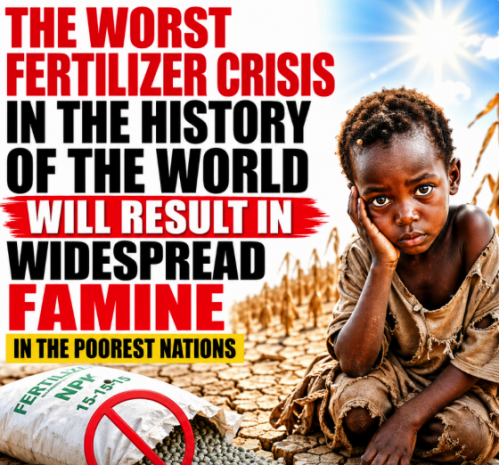
Thanks to the crisis in the Strait of Hormuz, there isn't going to be enough fertilizer for everyone in 2026. What is available is going to be gobbled up by the wealthy countries because they have the most money. Of course higher fertilizer costs will ultimately be passed along to consumers, and so we will all be paying much higher prices for food in the months ahead. But in the poorest nations on the entire planet, a lack of fertilizer could mean the difference between life and death. A dramatic reduction in the amount of fertilizer that farmers use will result in a dramatic reduction in the amount of food that is grown in those countries. Of course many of those countries were already dealing with very high levels of food insecurity, and the UN has admitted that acute hunger was already at the highest level ever recorded even before the war with Iran began. What the world is facing is unlike anything that any of us have ever seen before, and large numbers of people could literally end up starving to death.
I wish that I was exaggerating.
Without sufficient quantities of fertilizer, there is no way that we could possibly feed the 8 billion people that are living on this planet today.
Unfortunately for all of us, spring planting season is here and much of the world's supply of fertilizer is trapped because the Strait of Hormuz is closed…
But the share of world supply of urea – the most popular commonly used fertiliser – that typically passed through the strait before the conflict was more than twice that, at 43%.
For sulphur – used to produce phosphate fertilisers – the figure is 44%.
For anhydrous ammonia – another nitrogen fertiliser – 27% of global supply on average passed through the strait between 2019 and 2023.