










Breaking News
 Mercantilism: China and Beyond
 The Magician, the Martyr, and the 33% Solution: Why Every Trump Poll Slump Requires A Fake...
 'Bitcoin Isn't Going Anywhere': Trump Officials Discuss DOJ, FBI Refocus on Crypto Crime
 The Praxian Genocidal Kill Chain – Part 1
Top Tech News
 His grandparents had heart disease.
At 11, Laurent Simons decided he wanted to fight aging.
His grandparents had heart disease.
At 11, Laurent Simons decided he wanted to fight aging.
 Mayo Clinic's AI Can Detect Pancreatic Cancer up to 3 Years Before Diagnosis–When Treatment...
A multi-terrain robot from China is going viral, not because of raw speed or power...
 The World's Biggest Fusion Reactor Just Hit A Milestone
 Wow. Researchers just built an AI that can control your body...
 Google Chrome silently installs a 4 GB AI model on your device without consent
 The $5 Battery That Never Dies - Edison Buried This 100 Years Ago
 That is not a real fish. IT'S A ROBOT.
 Scientists Unveil Hemp Alternative to Plastic That Can Withstand Boiling Water...
 A Robot Economy: Who Gets Rich, Who Gets Left Behind


How Governments, Corporations, & Technocratic Systems Are Quietly Redefining Ownership...
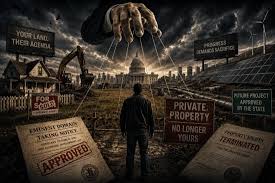
There are periods in history when societies begin to discover that the liberties they believed to be permanent were, in reality, conditional arrangements tolerated only while they remained politically convenient. Across the Western world, governments are quietly expanding the legal and administrative mechanisms through which private land can be reclassified, restricted, absorbed, or transferred in the name of infrastructure, sustainability, industrial security, climate adaptation, and economic modernization. Entire farming regions are now being surveyed for carbon pipelines. Rural communities are facing unprecedented redevelopment pressure linked to energy transitions and semiconductor expansion. Financial institutions are purchasing strategic agricultural land at historic levels while policymakers openly discuss the restructuring of urban life around centralized digital systems. Officially, these transformations are described as progress. Unofficially, an increasing number of citizens have begun to suspect that the modern definition of ownership itself is being rewritten in real time.
The New Architecture of Property Seizure
The modern citizen has been conditioned to believe that private property represents one of the sacred foundations of liberal democracy. Constitutions defend it, political campaigns celebrate it, and economists routinely describe it as the engine of prosperity and social stability. Yet beneath the ceremonial rhetoric lies a more fragile reality — one in which ownership increasingly resembles a conditional administrative privilege rather than an untouchable natural right. This contradiction becomes impossible to ignore when examining the doctrine of eminent domain, the extraordinary legal authority through which governments may confiscate private property without the owner's consent.
Supporters of eminent domain insist that such authority is indispensable for the functioning of modern civilization. Roads must be built, railways expanded, energy corridors connected, airports enlarged, water systems modernized, and industrial facilities constructed. In many cases, governments provide financial compensation to displaced owners, presenting the process as a rational exchange carried out for the collective benefit of society. Yet the deeper philosophical problem has never truly revolved around compensation. The more disturbing issue is whether property can genuinely be called "private" if the state ultimately reserves the authority to seize it whenever officials determine that a superior public or economic purpose exists.
Centuries ago, political philosopher John Locke articulated this contradiction with remarkable clarity in his Second Treatise of Civil Government, writing: "For I have truly no Property in that, which another can by right take from me, when he pleases against my Consent." Locke understood that property rights and liberty are inseparable mechanisms. If ownership exists only so long as political authorities permit it, then freedom itself becomes conditional. A citizen whose property may be overridden by state power is not fully sovereign over the fruits of his labor, his land, or his future.