










Breaking News
 Budget Steak Tastes Like $100 After This One Trick
 OPEC Fractures, the Draft Returns, and the Age of Consequences Begins
 China Confirms Boeing Jet Deal, Agrees To Cut Select Levies & Expand Agri Trade
 Here's Where Wealth Is Moving In America
Top Tech News
 US To Develop Small Modular Nuclear Reactors For Commercial Shipping
 New York Mandates Kill Switch and Surveillance Software in Your 3D Printer ...
 Cameco Sees As Many As 20 AP1000 Nuclear Reactors On The Horizon
 His grandparents had heart disease.
At 11, Laurent Simons decided he wanted to fight aging.
His grandparents had heart disease.
At 11, Laurent Simons decided he wanted to fight aging.
 Mayo Clinic's AI Can Detect Pancreatic Cancer up to 3 Years Before Diagnosis–When Treatment...
A multi-terrain robot from China is going viral, not because of raw speed or power...
 The World's Biggest Fusion Reactor Just Hit A Milestone
 Wow. Researchers just built an AI that can control your body...
 Google Chrome silently installs a 4 GB AI model on your device without consent
 The $5 Battery That Never Dies - Edison Buried This 100 Years Ago



OPEC Fractures, the Draft Returns, and the Age of Consequences Begins
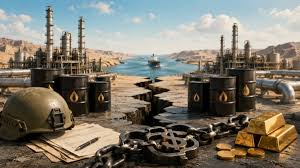
The United Arab Emirates recently announced it would quit OPEC after nearly six decades, striking a major blow to the oil cartel and to Saudi Arabia, its unofficial leader.
Let's be clear, the UAE didn't leave OPEC. They were bought out. You may recall that this event was preceded by two major developments that tell the actual story. The first was the shutting of the Strait of Hormuz (SoH). This bled UAE finances and continues to do so. It creates not only a loss of revenue but a shortage of dollars with oil being sold for dollars.
This is why the US provided the UAE with dollar swap lines. The UAE is also highly dependent on the US military not abandoning them. They already realise that has happened to some degree, but looking around their neighbourhood they realise they have no friends and so cling to whatever is left of US security promises.
The market immediately saw this as a step towards more production, since the UAE would no longer be constrained by OPEC's agreed quotas, but the reality is that productive capacity has been destroyed (refineries bombed, wells capped).
What's important to think about is that swap lines are nothing more than a credit card, and debt is the ultimate tool of slavery. From America's perspective, Bessent is using these for a couple of reasons.
First, as the Gulf states face financial difficulties there is a risk they begin selling assets. Those assets are, of course, US Treasury bonds. That's not good, especially as the US needs to continue financing the wars.
The second reason is to stop CNY settlement from scaling.
Swap lines give allies dollar liquidity, reducing their incentive to price oil or trade in CNY.
Personally, I think it's a bad deal. The Emirates just traded 60 years of sovereignty to become a debt slave. Every country that ties its survival to American goodwill learns the same lesson eventually: the US doesn't have allies, it has interests. And when those interests shift, you're fresh outta luck. This move doesn't strengthen them. It neuters them…
Ultimately, the war is being fought not only in the Middle East but in central bank boardrooms.
What we're seeing is a world forming where there will be multiple currency blocs and settlement structures. In a world where currency, settlement, and banking rails are all being weaponised, this is definitely a time to own precious metals.
Promised and Now Delivered
It gives me no pleasure pointing out things we've discussed at length in these pages over the last few years, only to have them come to fruition. We're as happy as the next guy making money, but when it comes to things like war, I'm frustrated and upset. Making money on such outcomes sucks, even though we're not funding the conflict (we would be if we were investing in defence stocks, I suppose).
The inevitability of war we've been discussing still doesn't make it necessary or just. Still, realism is what we must invest with.