










Breaking News
 Trump & NATO Kiss and Make Up as Europeans Pledge To Buy More U.S. Weapons
 Special Saturday Broadcast: Trump Just Threatened Iran With Total War If They Try To Assassinate...
 EXCLUSIVE: Los Angeles Gives Free Pass to Illegal Alien Food Vendors While Restaurants Must...
 Visualizing Europe's Soaring Youth Unemployment
Top Tech News
 Modular Reactors To Solve Data Center Hysteria?
 DeepSeek Developing In-House AI Chip In Bid To Cut Nvidia Reliance
 America just took three brand-new nuclear reactors critical in thirty days, a first for any...
 Your brain doesn't peak in your 20s after all: Study reveals your mind is at its sharpest betwee
 Compasses, not maps: China is building a different type of AI
 The Return of the Ekranoplan
 Farewell, atom-smashing Large Hadron Collider
 This is already starting.
 The Crosley IcyBall
 It's Not a Conspiracy Anymore: Med Beds Exist and Trump Knows It



Visualizing Europe's Soaring Youth Unemployment
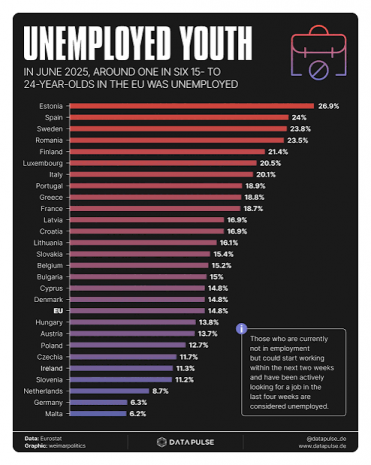
While some countries have relatively smooth transitions from education into employment, others continue to struggle with stubbornly high youth unemployment.
This visualization, created by DataPulse Research via Visual Capitalist, uses Eurostat data alongside additional analysis from DataPulse Research to compare unemployment rates among 15- to 24-year-olds across the EU in June 2025. Under Eurostat's methodology, unemployed young people are those actively seeking work and available to start within two weeks.
Europe's Youth Employment Divide
The table below ranks youth unemployment rates across EU member states in June 2025.

The spread is striking. Estonia's 26.9% rate is more than four times Malta's 6.2%, highlighting how dramatically employment prospects can differ across the bloc even as the EU-wide average remained steady at 14.8%.
Southern European countries continue to feature many of the highest rates of youth unemployment, with Spain (24.0%), Italy (20.1%), Portugal (18.9%), and Greece (18.8%) all posting elevated numbers. France also remained above the EU average at 18.7%, while Nordic economies presented a mixed picture, with Finland and Sweden ranking among the highest despite generally strong labor markets.
Why Are the Gaps So Large?
Youth unemployment reflects more than the health of an economy. Structural factors such as education-to-work transitions, labor market regulations, skills mismatches, and regional economic differences all influence how easily young people secure their first job. Research has long shown that these structural differences help explain why some European countries consistently experience higher unemployment than others.
Spain illustrates this complexity. Although the country continues to record one of Europe's fastest-growing economies, youth unemployment remains among the continent's highest, partly due to skill mismatches and regional labor market frictions.
At the same time, Spain has expanded pathways for international workers through new visa programs aimed at attracting talent in sectors facing labor shortages. Similar initiatives are appearing elsewhere in Europe as governments attempt to address demographic pressures and reduce hiring bottlenecks.