










Breaking News
 Ex-CIA Agent Speaks Out: JFK, 9-11, UAPs, MLK, MKUltra & Everything Trump Is Hiding
 China takes satellite race with SpaceX to sea
 The Low-T Issue
 Tesla Cybercabs and Superchargers Will Act as Mini Cell Towers for SpaceX Starlink
Top Tech News
 Elon Vows AI-Made 'Odyssey' After Blasting Nolan's Take On Homer
 Anthropic is launching its own drug discovery programs for rare diseases using Claude...
 SpaceX AI Satellites Will Have 250 Kilowatts of Power
 Chinese researchers have developed a sodium-metal battery that can fully charge in just 4 minutes...
 SpaceX Starship Flight 13 in 3 Days - Thursday July 13
 Chinese Scientists Develop Nuclear Battery Using Carbon-14
 Teleoperated humanoid robots complete first-ever live surgery
 Floating capsule auto-disinfects water without chemicals or battery
 Modular Reactors To Solve Data Center Hysteria?
 DeepSeek Developing In-House AI Chip In Bid To Cut Nvidia Reliance



Are Drone Swarms Going to Enable Big Land Gains in the Ukraine War ?
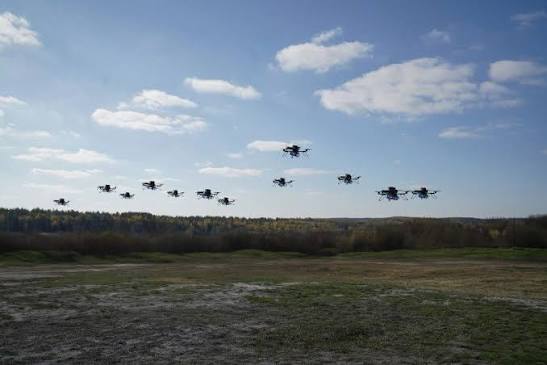
Ukraine's drone campaign has already moved beyond tactical harassment. By mid-2026 it is systematically degrading Russian logistics at operational depth, particularly along the southern land corridor into Crimea and the adjacent Zaporizhzhia–Kherson approaches. The question is no longer whether drones matter. It is when the next qualitative jump — from high-volume semi-autonomous strikes to coordinated packs and true swarms — crosses thresholds that force local Russian routing or collapse of sustainment on a decisive axis.
The Scalability Advantage
Historical analogies help frame the moment. German U-boats in the Battle of the Atlantic came close to choking Britain's supply lines, but their numbers were never infinitely scalable. Each submarine required long construction times, scarce materials, and highly trained crews. Allied counters eventually outpaced production and closed the gaps.
Drones reverse that constraint. Ukraine is producing millions of systems annually. Mid-range platforms with AI terminal guidance, optical navigation, and electronic-warfare resistance already operate routinely at 50–150+ km. Long-range variants reach well beyond 1,000 km. Because the platforms are cheap, iterable, and software-defined, the limiting factors are less industrial capacity than coordination, persistent coverage, and the ability to convert logistics friction into ground exploitation.
The closest historical parallel is not a single technology that magically broke trench warfare. It is the late-World War I combination of technologies and tactics that finally restored mobility after years of stalemate.
In 1914–1917, machine guns, barbed wire, and artillery created the trench deadlock. The breakthrough in 1918 (especially the Hundred Days Offensive) came from integrated combined arms: tanks to crush wire and suppress machine guns, refined artillery (predicted fire, creeping barrages), infantry trained in infiltration tactics, and air power for reconnaissance and ground attack. No one system was decisive alone. The game-changer was the ability to suppress the defender's firepower and logistics long enough for mobile forces to exploit.
What "Transform" Would Actually Look Like
A transformative effect would look like this.
Coordinated packs or early swarms hold throughput on a critical corridor (R-280 and approaches to Crimea) below the sustainment threshold for several weeks.
Russian units on that axis experience acute shortages of fuel, ammunition, and replacements.
Ukrainian forces concentrate and exploit the resulting weakness with artillery, drones, and limited mechanized pushes.