










Breaking News
 Ex-CIA Agent Speaks Out: JFK, 9-11, UAPs, MLK, MKUltra & Everything Trump Is Hiding
 China takes satellite race with SpaceX to sea
 The Low-T Issue
 Tesla Cybercabs and Superchargers Will Act as Mini Cell Towers for SpaceX Starlink
Top Tech News
 Elon Vows AI-Made 'Odyssey' After Blasting Nolan's Take On Homer
 Anthropic is launching its own drug discovery programs for rare diseases using Claude...
 SpaceX AI Satellites Will Have 250 Kilowatts of Power
 Chinese researchers have developed a sodium-metal battery that can fully charge in just 4 minutes...
 SpaceX Starship Flight 13 in 3 Days - Thursday July 13
 Chinese Scientists Develop Nuclear Battery Using Carbon-14
 Teleoperated humanoid robots complete first-ever live surgery
 Floating capsule auto-disinfects water without chemicals or battery
 Modular Reactors To Solve Data Center Hysteria?
 DeepSeek Developing In-House AI Chip In Bid To Cut Nvidia Reliance



China takes satellite race with SpaceX to sea
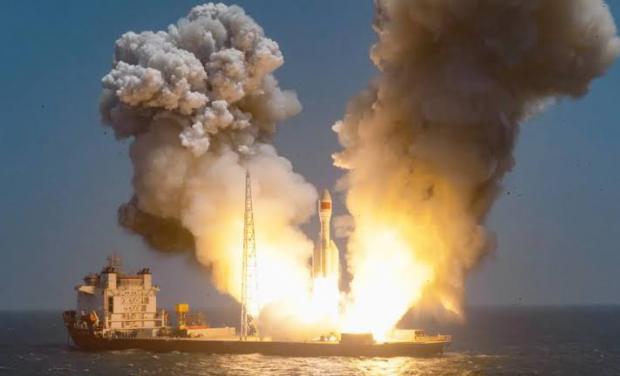
China's latest sea-based rocket launch shows how mobile launch platforms, onboard artificial intelligence and expanding commercial constellations are converging into a broader Chinese effort to strengthen military resilience, accelerate satellite deployment and compete for economic influence across an increasingly contested orbital domain.
This month, multiple media outlets reported that Chinese commercial launch provider Orienspace successfully launched its Gravity-1 solid-propellant rocket from a mobile launch vessel in the East China Sea off Shanghai, delivering nine payloads into designated low Earth orbits.
The 30-meter-tall, 405-ton launcher—recognized as the world's most powerful solid-fuel rocket, with 600 tons of liftoff thrust—completed its third successful orbital flight and demonstrated China's growing ability to conduct high-capacity offshore launches in support of increasingly ambitious commercial satellite constellations.
The mission deployed six Dongpo-series optical and synthetic aperture radar satellites (SAR) intended for regional mapping and emergency response, alongside two Earth observation satellites — Xiguang-2 01 and Tianyi-49 — and the Lilac-3 technical demonstration platform.
Notably, Marine Insight reports that Xiguang-2 01 is China's first satellite equipped with onboard AI capable of processing spatial imagery directly in orbit, potentially allowing collected data to be analyzed and distributed in near real time.
Managed in coordination with the Oriental Aerospace Port and the Taiyuan Satellite Launch Center, the long-range sea launch proved that solid-fuel rockets can remain safely stored aboard vessels for extended periods under far-sea ocean conditions, establishing an agile, high-capacity alternative to traditional land-based spaceport infrastructure.
Sea-based satellite launches provide several advantages over land-based launches. Using mobile sea-based launch platforms bypasses congested land-based spaceports while enabling fuel-optimal launch trajectories, maximizing payload capacity per flight.
Using offshore platforms may also support the recovery of high-cost first-stage boosters at sea through specialized net-capture systems, eliminating the need for heavy onboard landing legs, reducing rocket weight, improving fuel efficiency and allowing reusable launch vehicles to carry larger payloads.
Examining the military applications of these technologies, Corey Crowell and Sam Bresnick point out in a June 2023 report for the Center for Security and Emerging Technology (CSET) that China uses small, mobile and solid-fuel launch vehicles to reduce its reliance on vulnerable fixed land-based spaceports and provide a tactically responsive space launch capability.