










Breaking News
 The Economist Who Predicted 2008 Explains China's Endgame
 Charlie Kirk SNAPS at Anti White Masked ANTIFA
 Episode 488: THE FAUCI FIRESTORM
 Discussion with Glen Diesen
Top Tech News
 Voyager 1 approaches one light day from Earth
 Visual Implants
 Renewable Energy Breakthrough! World's Most Efficient Tesla Turbine System
 I Told You So
 Meet Sunbird, a nuclear fusion-powered space tug concept from Pulsar Fusion.
 China and Russia launch 29-nation AI alliance to rival western control of technology
 BREAKING: China has begun manufacturing domestically developed Immersion Deep...
 Idaho's High Desert Becomes Hot Spot For Nuclear Power Revolution
 The World's Largest Electric Aircraft Is About to Take Its First Flight
 Tesla Cybercabs and Superchargers Will Act as Mini Cell Towers for SpaceX Starlink



An Abandoned SpaceX Rocket Crashed Into the Moon. Here's What Happened
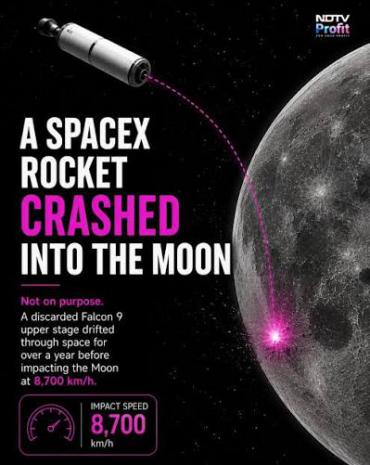
In January last year, SpaceX launched a Falcon 9 rocket with NASA and Firefly Aerospace's Blue Ghost lunar lander. The Blue Ghost went on to become the first commercially built lunar vehicle to land on the moon, and the reusable lower stage of the SpaceX Falcon 9 landed back on Earth. But the discarded upper stage of the Falcon 9 spent 18 months drifting in space before slamming into the surface of the moon at approximately 2:35 a.m. ET on Wednesday.
NASA, astronomers and other space agencies knew this was coming and have spent weeks preparing to see the rocket's violent descent to the moon's surface. That included tasking the Lunar Reconnaissance Orbiter and South Korea's Korea Pathfinder Lunar Orbiter with photographing the impact site before and after the crash to check out the moon's newest crater.
The Falcon 9's upper stage is the size of a five-story building and weighs as much as a heavy-duty pickup truck. NASA believes the resulting crater should be around 60 feet wide and 12 feet deep.