










Breaking News
 The World Is Running A Huge Oil Deficit, The SPR Hits A 4 Decade Low, And Diesel Shortages...
 Podcast - Larken Rose - Unbound: Breaking Mental Chains & Ending The Age of Masters
 The True Anarchy Of Self-Ownership And Health With Charlie Robinson
 They Really Don't Care
Top Tech News
 World's largest all-electric plane completes maiden flight
 The Lucid Cosmos Will Have More Range Than Any Tesla
 Strong 3D printable elastic polymer resists damage
 Double hydrogen-combustion car breaks world land speed record
 Vitalik Buterin Says Ethereum Is Betting Its Future On Quantum Security And AI
 Everything You Wanted To Know About Building A Cheap AI Setup (That Still Works)...
 If They Were Human, They'd Be Arrested. Experts Respond To Rogue AI Breaches
 Sodium Ion Batteries Will be 80% Cheaper & Last LONGER!
 German startup SAXON Q has introduced a diamond-based quantum computing system...
 Elon Musk To Build The Largest Building In The World - 100 Million Square Feet



The World Is Running A Huge Oil Deficit, The SPR Hits A 4 Decade Low, And Diesel Shortages...
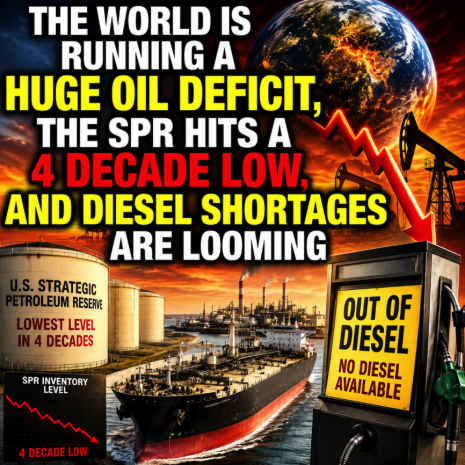
The world is barreling toward a historic energy crunch that will be unlike anything that we have ever seen before. When fighting with Iran erupted earlier this year, the global economy was absolutely swimming in oil. We literally had far more oil than we needed, but now commercial inventories have gotten extremely tight and national reserves are alarmingly low. If the Strait of Hormuz does not get reopened soon, we will quickly enter an immensely painful chapter of the global energy crisis. Energy prices will shoot way up and shortages will start to become a major issue. In fact, a global scramble for supplies of diesel fuel has already begun.
Right now the world is consuming far more oil than it is producing.
We have been running an enormous oil deficit for months, and the amount of oil that is coming out of the Persian Gulf is running at about half of pre-war levels…
Wall Street analysts – who use ship tracking services like Kpler and Windward Intelligence, among many other data points, to provide estimates about oil flows – have said oil tankers have been getting roughly 4 million barrels of oil out of the Persian Gulf each day.
In addition to the roughly 7 million barrels per day that Middle Eastern countries have rerouted around the strait through pipelines and other methods, about 11 or 12 million barrels have been flowing out, according to the tracking services. That's significantly lower than the 20 million barrels per day that the region had exported before the Iran war started.
We have been able to operate normally all this time because there was a tremendous amount of excess oil sitting around.
But now somewhere between 1.5 and 1.9 billion barrels of excess oil have disappeared…
Global inventories are between 1.5 billion and 1.9 billion barrels lower now than they were at the start of the war, depending on who's estimating. Massive crude stockpiles before the war helped prevent catastrophe when supply dried up.
Commercial oil inventories are exceedingly tight at this stage.
The good news is that there is still some extra oil remaining in the Strategic Petroleum Reserve.
The bad news is that the amount of oil in the Strategic Petroleum Reserve is now so low that we risk doing permanent damage if we continue to drain the salt caverns where the oil is stored…
The caverns that hold the U.S. strategic oil reserve could get damaged by the rapid release of stockpiles in response to the Iran war, experts warned this week as inventories hit a four-decade low.
Damage to the caverns would make it more difficult to respond to future energy emergencies, the experts said. The oil in the Strategic Petroleum Reserve, or SPR, is stored at 60 salt caverns thousands of feet underground at four major sites along the Gulf Coast in Louisiana and Texas.
300 million barrels is considered to be a danger point by many industry insiders.