










Breaking News
 Moody's Downgrades Baltimore City's Credit Rating Amid Population Collapse
 WNBA's most glamorous player Cameron Brink explodes at 'piece of s***' Enes Kanter Freed
 Taiwan Passes Massive $7,560,000,000 Drone Plan As China Threat Looms
 White House Ditches Outdated Climate Nightmares For Real-World Policy...
Top Tech News
 Singapore is experimenting with biological computing using living human neurons...
 It's Happening - Europe is Building an Impossible Fusion Reactor
 Portable 1MW Kaleidos Microreactor Secures Critical Nuclear Fuel Deal Through 2030s
 This New All-In-One Range Extender Is Ready To Go Into Any Electric Truck
 Aptera Reveals The Secret To Building Its Solar EV: China
 High-voltage sodium home battery emerges as affordable rooftop solar solution
 Peter Thiel-Funded Company Anduril to Triple the Number of Autonomous Surveillance...
 China has released Origin Pilot, claimed to be the world's first open-source operating system...
 ShieldAI XBAT Drone Fighters Can Give A Fighter Drone Wing to Every US Destroyer
 Brain organoids, kept alive more than five years, matured like human brains



Taiwan Passes Massive $7,560,000,000 Drone Plan As China Threat Looms
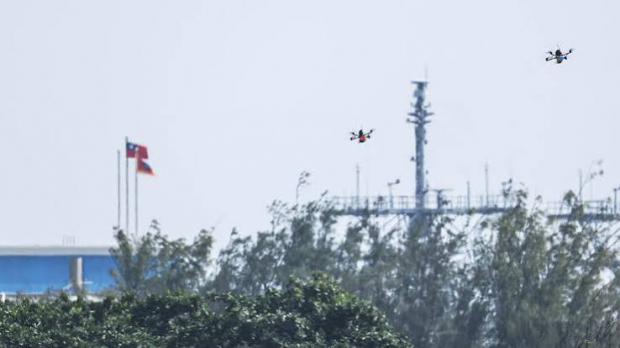
The opposition-led Legislative Yuan passed the six-year plan in a 60-50 vote, setting a spending cap of NT$240 billion (New Taiwan dollars), roughly $7.56 billion U.S. dollars, with additional funding allowed subject to legislative approval, Focus Taiwan reported. Lawmakers rejected the government's competing NT$210 billion, roughly $6.6 billion, special-budget proposal, which would have supported the purchase of roughly 210,000 unmanned systems through 2031, according to the outlet.
"Taiwan's massive investment in drones is incredibly important," Zack Cooper, a national security analyst and senior fellow at the American Enterprise Institute, told the Daily Caller News Foundation. "The Ukraine War has demonstrated how vital these capabilities are on the modern battlefield."
Ahead of Thursday's vote, Taiwanese President Lai Ching-te urged lawmakers Wednesday to back the government's package, framing the program as both a military requirement and a demonstration of Taiwan's willingness to defend itself, Reuters reported. Lai has argued that drones are becoming a central part of the island's effort to strengthen asymmetric capabilities against a much larger Chinese military, according to a statement from Taiwan's Presidential Office.
The government plan ran into resistance in Taiwan's opposition-controlled parliament, where lawmakers instead backed legislation that draws drone spending from the regular budget rather than a separate special appropriation. The law calls for the central government to earmark NT$40 billion annually for six consecutive years in principle and gives both the Ministry of National Defense and Ministry of Economic Affairs roles in implementing the program, Focus Taiwan reported.
Taiwan's drone buildup mirrors a U.S. military concept dubbed "Hellscape," under which American forces would flood the Taiwan Strait with thousands of unmanned submarines, surface vessels and aerial drones to disrupt a Chinese invasion and buy time for U.S., Taiwanese and allied forces to mount a broader response, U.S. Indo-Pacific Command chief Adm. Samuel Paparo told the Washington Post.
"I want to turn the Taiwan Strait into an unmanned hellscape using a number of classified capabilities," the Post reported, citing Paparo. "So that I can make their lives utterly miserable for a month, which buys me the time for the rest of everything."
"Now Taiwan must show that they can not only build drones, but also integrate them into individual units with the doctrine, training, and command and control changes that this will require," Cooper told the DCNF. "A mix of shorter and longer range systems will be necessary to build the sort of 'hellscape' capability that Admiral Paparo has talked about."