










Breaking News
 'Not Simple': Witkoff, Kushner Meet Putin For High-Level Peace Talks Under 72-Hour Ukraine A
 Iran: Several Ballistic Missiles Fired At US Aircraft Carrier, Navy Destroyer
 Why you won't be getting a flying car
 Iran war paranoia: Why did the US order lie detector tests for top military generals?"
Top Tech News
 Floating data center would provide water and electricity to 32,000 homes
 OpenAI Cuts Off Elon's Cursor, Humanity's First Star Probe, and Trump's Nuclear Mars Shi
 Eating pollution? Plastic-to-cookie technology raises safety, environmental concerns
 Ford's $30,000 Fathom EV Truck Appears More Conventional Than Expected
 Berlin-based artist Simon Weckert explored that idea with Digital Camouflage...
 Tether expands tokenization business into Saudi Arabia, starting with real estate
 Ukraine is facing a new problem in its war with Russia:
 It charges more than it discharges while driving
 Dataminr AI tech to go live on NATO Maven system: CEO
  The Most Dangerous Interview Ever Recorded? PART 2


Why you won't be getting a flying car
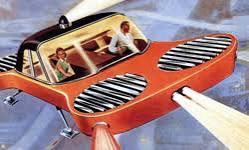
Stripe Press was kind enough to send me several books it had published, and one of these was J. Storrs Hall's "Where Is My Flying Car?".
I had been meaning to read this book for a while, especially after Tyler Cowen recommended it and Jason Crawford gave it a glowing review, so I was glad Stripe gave me a copy. I promptly stuck it on my shelf, paid for the audiobook, and listened to it while walking around San Francisco. That's called ordinary abundance, folks!
In 2011, Peter Thiel famously said: "We wanted flying cars, instead we got 140 characters." When I first saw that quote, I chuckled, because for my entire life, we've had flying buses.
And again and again, as I sit on a flying bus and marvel at the thrill of takeoff, and reflect on how amazing it is that man has conquered the air, I look around and see my fellow passengers with their window shades drawn, their noses buried in a book or staring at a phone.
If we had flying cars, we'd enjoy the thrill for a few weeks, and then we'd be back to tweeting on our phones and wondering when the trip would be over.
I've noticed a loose collection of beliefs and attitudes that I've decided to call "engineerism", because I see it most often among engineers. I coined the term when I was in college, when I noticed that the engineering majors in my physics classes tended to think differently about the world than the physics majors like myself did.
Later, I recognized "engineerism" in various sci-fi novels — "Lucifer's Hammer" and "Football" by Larry Niven and Jerry Pournelle, "The Peace War" by Vernor Vinge, and so on.[1]
When I say "engineerism", I am not talking about Friedrich Hayek's "engineering mentality" — the belief that society can be designed and optimized like a machine.[2] Nor am I referring to Evgeny Morozov's "technological solutionism", which is the idea that social problems can be fixed with technology.
If I had to define what I call "engineerism" in succinct, simple terms, it would be something like: "The idea that if a technology can be built, we ought to build it." Simply put, engineers like to engineer things, and they become disgruntled when society does not give them the resources to do this.
Of course, engineerism is not quite so simple in the real world. It involves a lot of thinking habits that come in handy in engineering — linear approximation, back-of-the-envelope calculations, and so on. And in America, it also involves a set of beliefs that have sort of accreted over the years — for example, a belief in the importance of nuclear power.