









Breaking News
 #689: The Empire of Lies | Charles Goyette
 One Arizona storm; 15 rain totes
 Teach AI Good Morality
 Guilfoyle Resigns at Trump's Request Following Credit Card Scandal
Top Tech News
 I Built a Website to Expose Solar and Battery Scams
 Whistleblower Issues Dire Warning: Rogue AI, Hacking Nuclear Programs...
 Multi-material insulation delivers up to 10,000 x the stiffness
 Anduril's plan to save US sub edge from China's undersea surge
 Researchers Develop AI 'Mind-Reading' Tool That Reconstructs What Your Eyes See
 Video: Dexterous robot hand learns the delicate art of silk embroidery
 The computer that can read your mind:
 Seven apps. One craft
 SHOCK CASE REPORT: Advanced Alzheimer's Patient Regains Speech, Memory, Mobility...
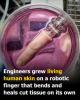 Most artificial limbs rely on silicone or plastic to mimic human hands.



153 Nations Adopt UN Pandemic Declaration to Push FAST-TRACKED Vaccines Within 100 Days...
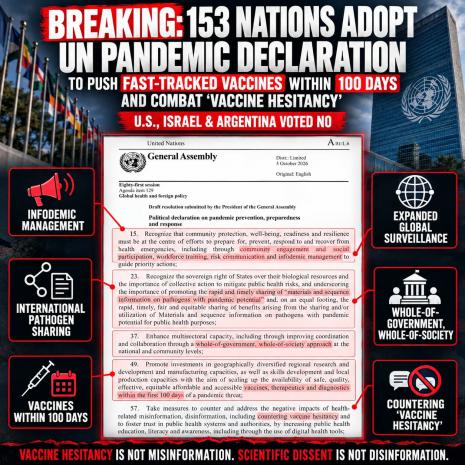
On October 12, 2026, the United Nations General Assembly adopted a new pandemic declaration, with 153 countries voting in favor, three against, and two abstaining. The United States, Israel, and Argentina voted against the declaration.
Buried within the nine-page document is a provision that should concern anyone who values scientific freedom, informed consent, and the right to question public-health authorities.
Paragraph 57 explicitly calls for governments to counter vaccine hesitancy as part of broader efforts against health-related "misinformation" and "disinformation."
The declaration goes even further, explicitly endorsing "infodemic management" and a "whole-of-government, whole-of-society" pandemic response.
This sounds like more scientific censorship, lockdowns, and experimental vaccine mandates.
The sweeping declaration also promotes:
• VACCINES WITHIN 100 DAYS: Scaling up vaccine, therapeutic, and diagnostic availability within the first 100 days of a pandemic threat, raising concerns about another Operation Warp Speed disaster.
• EXPANDED GLOBAL SURVEILLANCE: Strengthening disease-monitoring networks, early-warning systems, laboratory capacity, and digital health infrastructure, raising concerns about privacy breaches and oversight.
• INTERNATIONAL PATHOGEN SHARING: Promoting rapid sharing of potentially dangerous pathogen materials and genetic sequences across borders, raising concerns about biosafety.
• BILLIONS IN PANDEMIC FUNDING: Highlighting a $15 billion annual preparedness financing gap while encouraging expanded international funding, public-private partnerships, and support for the WHO.
• SUPPORT FOR THE WHO PANDEMIC AGREEMENT: Endorsing further negotiations to finalize the agreement's pathogen-sharing provisions and facilitate future signature and ratification.
The declaration is non-binding and does not itself authorize censorship, compulsory vaccination, or expanded WHO enforcement powers. However, it establishes a broad international policy agenda that seriously endangers health freedom.