










Breaking News
 Robert Scott Bell Interview: The MAHA Substack Firestorm, a Failing Western Medicine...
 Worse Than 2008. Worse Than COVID. And They Call It a Boom.
 We Should Celebrate When Entrepreneurs like Musk, Jobs and Bezos Succeed
 Elon Musk: What Comes Next for Humanity
Top Tech News
 Anduril's plan to save US sub edge from China's undersea surge
 Researchers Develop AI 'Mind-Reading' Tool That Reconstructs What Your Eyes See
 Video: Dexterous robot hand learns the delicate art of silk embroidery
 The computer that can read your mind:
 Seven apps. One craft
 SHOCK CASE REPORT: Advanced Alzheimer's Patient Regains Speech, Memory, Mobility...
 Most artificial limbs rely on silicone or plastic to mimic human hands.
 Flying cell tower beams phone signal to Japan from 10 miles up
 Chinese Commercial Reactor Achieves Nuclear Fusion with Clean Hydrogen-Boron Fuel
 Palmer Luckey: Autonomous Weapons Are Ancient and Why Anduril Won't Build Humanoids | EP #295



The computer that can read your mind:
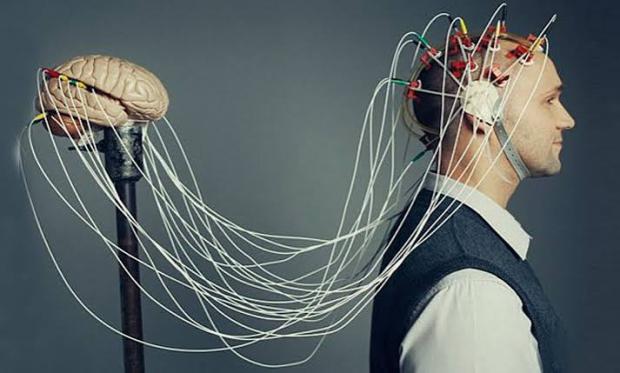
The days of keeping your thoughts to yourself may be numbered.
Scientists have unveiled a groundbreaking 'mind-reading' AI that can recreate images people are looking at simply by analysing their brain scans.
As part of a study, participants were asked to look at photos ranging from images of a baseball game to a dog leaning out of a car and a group trekking across a snowy plain.
The AI programme analysed their brain activity patterns through a scan and reproduced the pictures – which it had never seen before – with remarkable accuracy.
'There exist nowadays models that translate brain activity into images, and they can even produce impressive reconstructions that preserve the semantic meaning of the image reasonably well,' Professor Michal Irani, from the Weizmann Institute of Science, said.
'However, they tend to make mistakes in basic features such as composition and colour.
'The new model we developed outperforms them in reconstructing both the content of the image and its details.
'What's more, while every other model requires dozens of hours of brain scans to learn to "read" a new person, our model needs only one hour.'
To build the system, called Brain-IT, the scientists fed it thousands of brain scans collected while eight volunteers looked at different images.
This allowed the programme to learn how specific patterns of neural activity correspond to colours, shapes and objects.
It was so accurate that it even learned to predict what a brain scan would look like from an image.
By combining data from multiple studies, the researchers identified brain regions that appear to perform similar functions across different people.
For example, one area consistently responded to images of food while another was activated by pictures of sport.
'During training, the encoder naturally identified 128 functional regions that are shared by all people and perform specific roles in image processing,' Professor Irani said.
'Some of them are familiar to neuroscientists, but others are entirely new.
'For example, we discovered a division of roles within the brain region that processes images of places – the PPA – with one part responding to indoor scenes and another to outdoor scenes.'
When given a new brain scan, the AI was able to generate a remarkably accurate reconstruction of the original image.