










Breaking News
 At least seven dead and dozens injured after explosion at Canadian military base...
 BYD's flagship e-SUV packs insane 9-minute flash charging
 The Narrative On Trial | Full Oral Plea | English Language Version
 Honda is working on in-road wireless magnetic EV charging system
Top Tech News
 I Built a Website to Expose Solar and Battery Scams
 Whistleblower Issues Dire Warning: Rogue AI, Hacking Nuclear Programs...
 Multi-material insulation delivers up to 10,000 x the stiffness
 Anduril's plan to save US sub edge from China's undersea surge
 Researchers Develop AI 'Mind-Reading' Tool That Reconstructs What Your Eyes See
 Video: Dexterous robot hand learns the delicate art of silk embroidery
 The computer that can read your mind:
 Seven apps. One craft
 SHOCK CASE REPORT: Advanced Alzheimer's Patient Regains Speech, Memory, Mobility...
 Most artificial limbs rely on silicone or plastic to mimic human hands.



The Mexican Government Is Close to Approving a Law Aimed at Removing the Use of Cash
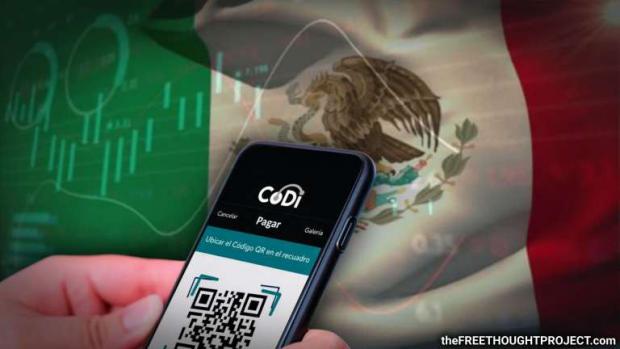
(The Last American Vagabond) On Wednesday, the Mexican government inched closer to passing a law that would begin the process of phasing out cash payments and requiring digital payments.
The "Digital Economy Law" was first introduced by President Claudia Sheinbaum in early September and has since moved rapidly through official commissions and the Chamber of Deputies. Most recently, on October 14, the bill passed out of two Senate commissions and now awaits a full Senate vote in the coming weeks.
The bill is part of an ongoing effort by the Sheinbaum government and the Morena party to expand the digitization of Mexico's economy. It instructs Mexico's Ministry of Finance and Public Credit (SHCP) to designate which business sectors will eventually only accept digital and electronic forms of payment.
While Mexico already has existing digital infrastructure, such as the SPEI (Sistema de Pagos Electrónicos Interbancarios) and the CoDi and DiMo networks, the public's embrace of these systems has been slow. The Digital Economy Law is aimed at increasing the use of such digital payment platforms.