










Breaking News
 The EU Met Its Waterloo in Warsaw
 The Battle According to Q
 America's Debt Trap: Washington Is Running Out of Time
 The Erasure of Western Civilization Accelerates
Top Tech News
 PRP vs Exosomes vs Stem Cells: Which Fits Your Condition?
 SHOCKING: The Secret (Frantzve) Family Business
 Microreactor Gets DOE Approval for Full Power Testing, Previously Contracts with Army...
 Ford Fathom: Everything We Know About The Sub-$30,000 Affordable EV Truck
 Love it or loathe it, AI is birthing a golden age of science
 SpaceX has no competition -- Saurav Shroff, Starpath
 Living computers forge a 'hive mind' and work together to outsmart AI
 The Faraday duffle bag: A digital lifeline in a surveillance-saturated world
 Delivery Robots Accused Of Scanning Customers' Faces, Sharing Biometric Data
 FDA-Approval for Drill-Free Cavity Care May Be Imminent After Great Phase 3 Treatment Trial



Scentronic tech lets you smell the internet
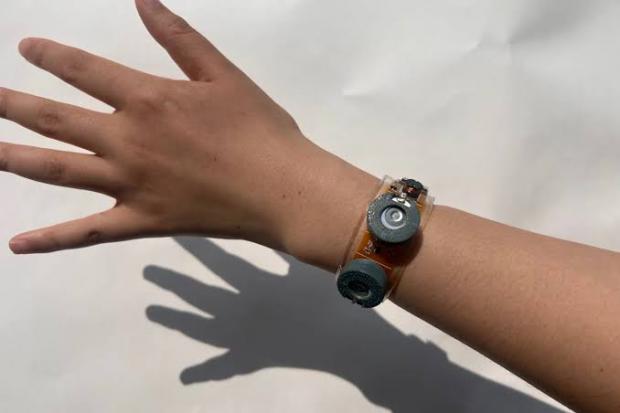
Well, that may soon be a thing of the past, as scientists have figured out a way to transmit smells over the internet. Technically speaking.
Researchers at The Ohio State University and Zhejiang Laboratory in China have created a system that detects an odor in one place and reproduces a corresponding scent somewhere else.
The system consists of two devices: an electronic nose (e-nose) that sniffs out airborne chemicals at the sending end, and a device called Scentronic that releases fragrances at the receiving end. Machine-learning software and the internet connect the two. So far, the team has demonstrated the system with beer, cake, coffee, oranges and red wine.
We've long ago figured out how to capture and transmit sights and sounds. Specialized devices can even reproduce aspects of touch. Smells, however, have proved trickier. A camera records light falling on a sensor, while a microphone records changes in air pressure caused by sound waves. Both light and sound follow the laws of physics, a framework that works perfectly with electronics, allowing them to be digitally replicated.
A smell, however, is chemistry, comprising molecules floating through the air, often in complex mixtures. Their identities and concentrations determine what you perceive. An aroma has no straightforward equivalent to a photograph or audio file. So how do you capture one, and how do you convert what you've captured into digital signals? These are the questions the researchers set out to solve.
The e-nose takes the form of a circular circuit board carrying six metal-oxide semiconductor gas sensors. Their main sensing material is tin dioxide.
In ordinary air, oxygen molecules settle onto the sensor surfaces and draw electrons away from the material, increasing its electrical resistance. When volatile organic compounds (VOCs) from food or drink reach those surfaces, some react with the adsorbed oxygen and return electrons to the tin dioxide. Resistance drops, and the circuit registers a corresponding specific rise in voltage.
Ethanol from alcoholic drinks, limonene from citrus, and diacetyl from buttery aromas are some of the VOCs that can produce these reactions. Because each sensor responds differently, each source produces a distinctive voltage pattern across the array. Think of it as a chemical fingerprint, albeit a fairly blurry one.
Now, data that vaguely matches a scent to a voltage pattern is available. However, precise matching is necessary for the system to be useful. For this, the researchers turned to AI.