










Breaking News
 Ukrainian Intelligence Just Tried Its Own Version Of The Israeli Pager Attack
 Futures Mixed As America Votes, Apple Slides And Oil Rebounds After "Defensive" US Strike
 Second Wave Of Cyberattacks Paralyze Supermarket Fridges Across EU, Weeks After Gov'ts Urged...
 Alarming Abuse Identified In Secret Ukraine Azov Battalion Detainment & Forced Conscript...
Top Tech News
 PRP vs Exosomes vs Stem Cells: Which Fits Your Condition?
 SHOCKING: The Secret (Frantzve) Family Business
 Microreactor Gets DOE Approval for Full Power Testing, Previously Contracts with Army...
 Ford Fathom: Everything We Know About The Sub-$30,000 Affordable EV Truck
 Love it or loathe it, AI is birthing a golden age of science
 SpaceX has no competition -- Saurav Shroff, Starpath
 Living computers forge a 'hive mind' and work together to outsmart AI
 The Faraday duffle bag: A digital lifeline in a surveillance-saturated world
 Delivery Robots Accused Of Scanning Customers' Faces, Sharing Biometric Data
 FDA-Approval for Drill-Free Cavity Care May Be Imminent After Great Phase 3 Treatment Trial



BYD's 300-MPH Electric Hypercar Crashed During Testing. The Driver Survived
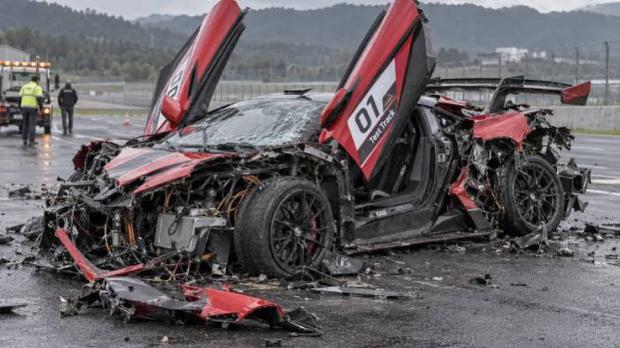
Making the world's fastest car comes with bragging rights, but that doesn't mean much if safety is put second. Thankfully, that doesn't seem to be the case with BYD's Yangwang U9 Extreme, a Chinese-made electric hypercar that made headlines last year when it broke the 300 miles per hour barrier, securing its place among automotive royalty.
The world's fastest car crashed hard during what looks like high-speed testing, but the driver reportedly walked out on his own without severe injuries, according to CarNewsChina. That can't be said for the car, though. After hitting a barrier at an undisclosed speed, the two-door hypercar's front and rear sections disintegrated, leaving just the central passenger compartment relatively intact. There were no reported battery fires.
BYD claims the U9 Extreme's safety structure is based on a carbon fiber passenger cell designed to provide high torsional rigidity and protection in a crash. The automaker didn't say when and where the crash occurred, but it was likely during a new speed record attempt.
In September 2025, the 2,977-horsepower hypercar hit 308.4 miles per hour (496.22 kilometers per hour), surpassing big names like Bugatti, Rimac, and Koenigsegg. But the title of fastest car in the world apparently isn't enough for the Chinese automaker, with BYD setting its sights on the 500 kph (310.6 mph) target.
The potential run was confirmed by Stella Li, BYD's executive vice president, who seemed confident that the mind-boggling speed is achievable in its road-going, limited-run EV. After last year's record run, the test driver said that he could have kept his foot on the throttle for another second and a half longer, according to the data. Whether or not that would be enough to squeeze an extra 2 mph is anyone's guess, but there's no denying that BYD tried.
Now, it's unclear what will happen with the automaker's record ambitions. Just 30 units of the Yangwang U9 Extreme are scheduled to be built, and with one out of the picture, a new attempt at hitting 310 mph might be delayed.
As its name suggests, the Extreme is the most outrageous version of the U9 supercar. Sporting a 1,200-volt electrical system, Yangwang's headline-making two-door sports car has four electric motors and a lithium iron phosphate (LFP) battery with a 30C discharge rate. Titanium calipers and carbon-ceramic rotors help slow down the EV, helped by a set of GitiSport e-GTR2 Pro semi-slick tires that were specifically developed for speeds of up to 310.6 mph.