










Breaking News
 Bill Gates: A Huge Catastrophe May Be Needed...
 New Congress, Same Debt: Our Next Fiscal Crisis Is Already on the Calendar
 Dead Simple Apocalypse Power: Build It in an Hour
 ALEX JONES RETURNS TO FORMER INFOWARS STUDIO
Top Tech News
Dead Simple Apocalypse Power: Build It in an Hour
 Gritt and MasTec partner to bring physical AI to solar construction sites
 Baby it's cold INSIDE! Scientists create the coldest temperature ever recorded in the lab...
 I am IN LOVE with AIRCRETE! Off-Grid, Earth-Covered Dome
 Musk's Starlink Is Building An Orbital Bypass As Undersea Cable Sabotage Threats Mount
 A robot just built a structure in space for the first time
 The Greatest Theft in Human History
 3D-Printed Tungsten Survives 74 Fusion Plasma Discharges, Advancing the Engineering...
 Dude turns a $23 used smartphone into the 4G brain of an RC aircraft.
 China's World-Beating Supercar Just Hit 312 MPH



New Congress, Same Debt: Our Next Fiscal Crisis Is Already on the Calendar
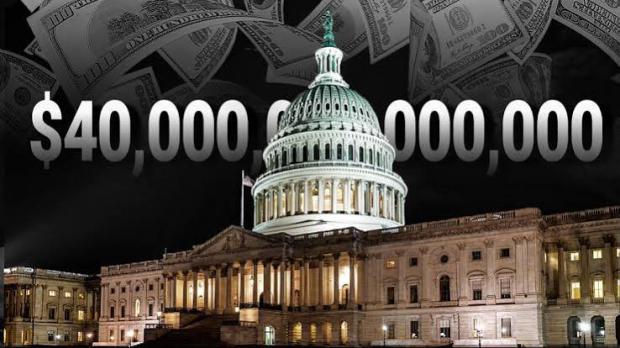
On Tuesday, voters in the US decided that the Democrats should control both chambers of Congress. When the new members take office in January, they will have gavels in both chambers, chairs of all committees, and access to investigative powers that they will no doubt use. They will also inherit more than $40 trillion of national debt, $32.7 trillion of which is held by the public, and a looming debt ceiling of $41.1 trillion. At today's pace, we will reach that debt ceiling in the first half of 2027.
In October, the International Monetary Fund (IMF) warned that heavily indebted governments must confront their fiscal challenges before they become unmanageable. The IMF points out that the interest rate on government debt has been rising, meaning that governments will have to spend increasing amounts of money servicing the debt over time. Between February and September, the average 10-year government bond yield across the G7 rose by more than a full percentage point and is now at multidecade highs. For the US, specifically, the IMF found that "evidence shows that long-term forward rates have become more sensitive to projected government debt in recent years." Bond markets are beginning to lose patience.
A one-percentage-point rise in bond yields doesn't sound like much, but against the $32.7 trillion in debt held by the public, that eventually adds $327 billion per year in interest payments (though not all at once). Note that that is an additional cost, not the total. In 2026, the federal government spent $1.05 trillion on interest payments. If bond yields increase by another percentage point, we'll owe $1.37 trillion in payments, and that's assuming that the federal debt doesn't increase further, which is a bold assumption.
For years, low interest rates made that borrowing seem cheap. In 2021, the Treasury paid just 1.6 percent on debt. Today, it pays 3.5 percent, and that figure is expected to rise in the coming years. And since the Treasury has been increasingly using short-term bills, the interest rate on our current debt will continue to rise. This is like signing up for an adjustable-rate mortgage knowing full well that rates will climb, and then continuing to pay the minimum payment every month.
The incoming majority's early priorities suggest reducing the debt may take a back seat to new spending commitments. While campaigning on affordability, several of the Congresspeople-Elect have signaled a desire to restore the Affordable Care Act subsidies initially put in place during the pandemic. These subsidies were initially billed as "temporary," in part because the pandemic was recognized as being temporary but also because a temporary spending measure receives a much lower cost estimate in federal budget projections. But as Milton Friedman used to say, "there's nothing so permanent as a temporary government program." Then there's restoring the Medicaid cuts, which would cost around $880 billion over the next ten years.
To pay for all of this, there will no doubt be calls for higher taxes. The IMF itself says that countries facing high structural debt need to "strengthen tax systems" to reverse course. Some on the New Right have agreed that a "grand bargain" will have to occur that pairs higher taxes with promised spending cuts. While this is intuitively appealing, it runs into serious problems.