










Breaking News
 Checking your Airbnb for hidden cameras will do you no good when they're this small.
 25 Foods You Must Hide Before the Disaster (The Cellar and the Hungry Months)
 How to Prep for a Cyberattack
 BREAKING: Leopold Aschenbrenner just filed his Q3 13F.
Top Tech News
 Extraterrestrial habitats may rise via Legos of laser-fused moon dust
 Battery-only 19-seater puts China in the electric airliner race
 Dream Chaser space plane gets landing approval for debut mission in 2027
 SpaceX Just Caught Starship on Its FIRST Attempt!
 Solid-State Cells Can Make The U.S. Competitive In Batteries Again: CEO
 Jetson ONE personal eVTOL pod is about to go full sky patrol
 America's INSANE BREAKTHROUGH Could Replace Septic Tanks Forever
 Amazing DIY Building Material for Home & Yard - Inexpensive and Easy!
 Researchers have discovered a massive deposit of hidden water...
 Amazon's Ring Unveils Flying Drone And Robot To Patrol Homes And Businesses



25 Foods You Must Hide Before the Disaster (The Cellar and the Hungry Months)
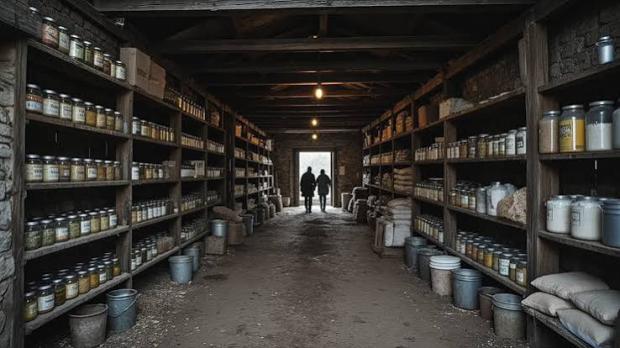
Break one link and the shelves empty from the front backward. Texas went through it in February 2021 with ice and a failed grid, and Tokyo's suburbs went through it within hours of the T?hoku earthquake in 2011, in a country that had rehearsed for that morning for decades.
The British emergency-planning phrase "nine meals from anarchy" oversimplifies the arithmetic, but it points at something real. Most houses hold somewhere between three and five days of edible calories, a rough figure rather than a measured one and close enough to plan around. Cut the trucks for a week and a household eats through the refrigerator in the first thirty-six hours, then starts rationing crackers.
Push the outage to a month and the question stops being about convenience. A diet, in the physiological sense, is a quantity of energy, protein, fat, and roughly thirty micronutrients arriving on a schedule the body can absorb without degrading, and that is an engineering problem with a calculable answer. Almost nobody calculates it in advance. (Watch this video to learn how to protect your food supplies when shortages hit!)
So run the numbers, because the numbers are the only part of this that stays calm. Four adults at two thousand kilocalories each for ninety days comes to seven hundred twenty thousand kilocalories. Stored as white rice at about sixteen hundred fifty kilocalories per pound, that is roughly four hundred forty pounds before protein, fat, or a single vitamin enters the sum. At something like thirty-five to forty pounds per five-gallon bucket, it fills eleven or twelve of them, which fits under a staircase and represents more food than most households buy in a year of ordinary shopping. Buying it in one weekend is how stockpiles fail: the household picks something it does not like, stores it badly, and quits by March.
Storage has enemies and they are unglamorous. Oxygen oxidizes fats and destroys vitamins in grain. Moisture invites mold and, in corn and peanuts, the molds that produce aflatoxin. Heat above about seventy-five degrees accelerates every decay reaction you are trying to slow, and light bleaches what heat does not finish. Insects and rodents arrive through seams you did not know existed. None of that yields to a bigger cupboard. It yields to Mylar, oxygen absorbers, rigid food-grade containers, a cool dark room, and honest rotation.
Most published lists fail at the selection stage, because they are pantry lists with the volume turned up: canned soup, breakfast cereal, spaghetti sauce, jerky, hard candy. All fine, most of them a poor foundation. A foundation needs calorie density, stability without refrigeration, and enough nutritional breadth that a family can live on it for a season without developing scurvy or losing muscle. Snack food has none of those properties and nothing requiring a freezer has the first two.