










Breaking News
 Bessent: Trump And Xi Agreed AI 'Should Not Be Allowed To Be Autonomous For Major Military Actio
 Think NYC Is Bad Now? Watch What Happens As Socialist Experiment Takes Shape
 Tesla Rolls Out "GTA-Style" Reality View For Full Self-Driving
 PASSIVE AGGRESSIVE
Top Tech News
 Dubai Just Finished the World's First Permanent Air Taxi Route: Airport to the Marina in Under 1
 Doroni Aerospace Raises More than $60m for H1?X Development
 After 13 Years Battling Cancer, a 61-Year-Old Brazilian Man Achieved Complete Remission...
 Extraterrestrial habitats may rise via Legos of laser-fused moon dust
 Battery-only 19-seater puts China in the electric airliner race
 Dream Chaser space plane gets landing approval for debut mission in 2027
 SpaceX Just Caught Starship on Its FIRST Attempt!
 Solid-State Cells Can Make The U.S. Competitive In Batteries Again: CEO
 Jetson ONE personal eVTOL pod is about to go full sky patrol
 America's INSANE BREAKTHROUGH Could Replace Septic Tanks Forever



PASSIVE AGGRESSIVE
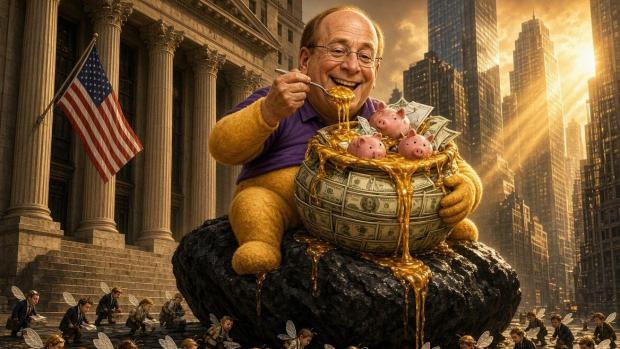
Every two weeks, tens of millions of Americans perform the same quiet ritual. A slice of their paycheck leaves their bank account, enters a 401(k), and buys the S&P 500 at whatever price the market asks. No one checks the price. No one reads the balance sheet. No one asks what is being bought. It is the most disciplined act of collective indifference in financial history, and Wall Street has learned to love it the way a fox loves an unlocked henhouse.
People were told this was prudence. "You can't beat the market, so own the market." Low fees. Broad diversification. Sleep well. The Macro Butler has no quarrel with low fees. His quarrel is with the word "diversification", which has quietly changed its meaning while nobody was watching. As of end October 2026, ten stocks made up roughly 39% of the S&P 500. Three of them alone exceeded 21%. The Information Technology sector touched 40% of the index. The "diversified" investor now owns a leveraged bet on artificial intelligence, a lightly disguised Nasdaq tracker, wrapped in the respectable tweed of a 500-company index.
Passive investing aims to replicate a market index rather than beat it. The passive investor buys the index, avoids frequent trading, and minimises costs. The objective is explicit and modest: match the market, not outperform it. The typical tools are S&P 500 index mutual funds and ETFs such as SPY, IVV and VOO, which together hold a remarkable share of all money in US ETFs.
The philosophy rests on four beliefs:
1. Markets are largely efficient, so prices already reflect available information.
2. There is no need to pick winners, because the winners are already in the index.
3. A low-cost structure compounds into a meaningful advantage over decades.
4. Long-term, buy-and-hold exposure beats tinkering.