










Breaking News
 This is the future we shall bring into being
 Elon Musk's Vision For The Future Looks Like A Movie
 Phosphorus Munitions Fired by Israel Burn Groves, Orchards in Southern Lebanon
 Iran's IRGC Warns It Will Expand 'Geography of the War' If the US Attacks Again
Top Tech News
 BEYOND THE MOON: NASA plans a nuclear-powered fleet to push DEEPER into space
 Big Oil Backs Mazama's $135 Million Bet On Superhot Geothermal
 Quantum compass takes flight on Northrop's Lumberjack drone
 Terrifying AI Behavior Even Its Creators Couldn't Explain
 WW3 Near-Miss? AI Hallucinated Nuclear Weapons Components Aboard Chinese Vessel Bound For Iran
 Stripe Is Building the Toll Road for the Machine Economy
 Toyota Dakar hopeful swaps twin-turbo V6 for hydrogen fuel cells
 4-min turbo-inflatable cubic camp castle is now available in the USA
 Researchers Used Claude To Hack OpenAI Employee Accounts
 Chinese Scientists Develop New Oil Refining Method That Cuts Energy Use by 90%



US Navy will fire 150 kilowatt laser on a test ship in 2018...
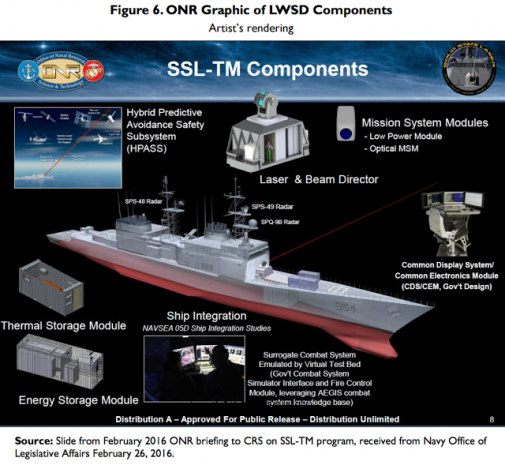
The USNavy plans to fire a 150-kw weapon off a test ship within a year, he said. "Then a year later, we'll have that on a carrier or a destroyer or both."
That's quite a jump from the kw AN/SEQ-3(XN-1) Laser Weapon System (LaWS), which deployed in 2014 on the amphibious transport dock USS Ponce.
And the kind of power needed to power such a weapon won't come with a simple flip of a switch.
"The Navy will be looking at ships' servers to provide three times that much power," says Donald Klick, director of business development, for DRS Power and Control Technologies. "To be putting out 150 kws, they (the laser systems) will be consuming 450 kws."
That is more than most currently operational ships are designed to accommodate, at least when they are conducting other tasks.
Few power systems onboard ships can support sustained usage of a high-powered laser without additional energy storage," noted a recent Naval Postgraduate School paper titled "Power Systems and Energy Storage Modeling for Directed Energy Weapons".