










Breaking News
Trump's War In Iran Is Not Destroying Iran; It Is Destroying AMERICA
 NASA Chief: "We Just Built Antigravity Propulsion!"
 Carl Higbie (NEWSMAX) says LIVE on TV: "The Senate is supposed to vote on the Clarity Act NEXT
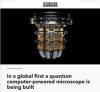 Quantum computing may soon become part of the microscope itself.
Top Tech News
Quantum computing may soon become part of the microscope itself.
 Volkswagen Just Unveiled The Most Efficient EV Ever Tested
 NASA Super Light Solar Sail Project Will Be 12-40 Times Lighter and Faster
 Space Telescope Interferometer to Image Exoplanet Continents
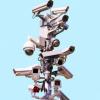 Twenty-five years of "temporary": how 9/11 built a surveillance state Americans never vote
 I'll Never Buy Another WALMART Battery!
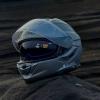 Shoei GT-Air 3 Smart helmet drops with built-in AR for $1,500
 AI Whistleblower Tells Tucker How AI Could Kill All Humans by 2040
 You Hate Flock? Well There's More...
 Will Spiking Diesel Prices Drive Autonomous Trucking?



Perfectly secure quantum communication

A one-time pad message can be sent securely using quantum mechanics and now also send the original message can be sent securely.
Physicists could check quantum states to see if a one time pad message had been overheard. The leakage is detected after it has occurred. An eavesdropper would already have the information by the time physicists found out.
For a one-time pad, a set of random numbers that can be used to encrypt a message. If the one-time pad is overheard, physicists simply disregard it and send another, until they can be sure that the process was completely private.
Getting rid of one-time pads would make sending secure messages far simpler.
The new method uses some initial photons to check for eavesdropping if there is none then the message is sent.