










Breaking News
 EXCERPTS: Citigroup Inc. received approval to launch a wholly-owned securities business...
 The Crown Wants It Kept Secret: AG Asks the Federal Court to Seal Information...
 The Supreme Court Just Denied Your Constitutional Rights
 The state is trying to crush the Amish with ruinous penalties.
Top Tech News
 Modular phone promises total privacy at the flick of a switch
 Genetically Engineered War Dogs for 134 Pound Cyborg Dire Wolves Now – Later 600 Pound Wolves
 They're Quietly REPLACING Our Food With THIS… And Nobody Is Talking About It!
 Chicago Opens First "Teacher-Free" AI School as Global Push Accelerates
 Solar Panels Are Doing Something Nobody Expected
 DeLorean climbs skyward to race electric flying cars
 Atari's 800XL returns with a keyboard, cartridges and BASIC
 Bioinspired robot airdrops into remote waters via morphing wing-sail
 Anduril interceptor adapts to emerging threats via swappable stages
 I Built a Website to Expose Solar and Battery Scams


How 3D printing is disrupting the architecture and design industry
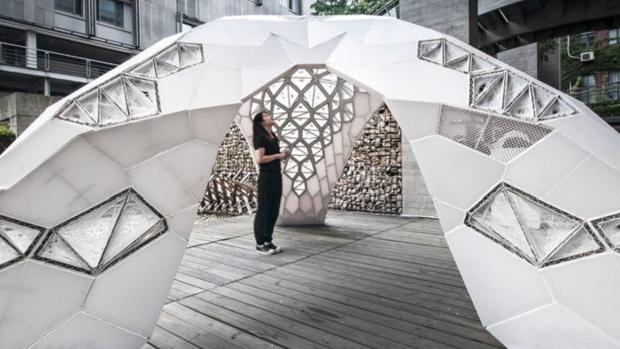
Some consider it the beginning of the third industrial revolution, while others point out the constraints of the technique. Is 3D printing changing our architecture, and is it the way we'll design our homes in the future? Below, we look at the phenomenon of 3D printing worldwide, including a delicate resin pavilion in China, classical-design-inspired concrete beams in Italy and buildings that "think" in Germany.
The technology of 3D printing was invented by Chuck Hull, an American engineer. He initially called the new process stereolithography and patented it in 1986. The technique links molecules using laser light to form polymers into solid shapes.
Initially, industries such as automotive manufacturing used the technology for what became known as rapid prototyping. The advantage was that no molds were required and there was no waste, unlike in milling, where a shape is cut and the material around it is discarded. In 3D printing, objects are constructed layer by layer. The idea stems from printing with ink; in that process, the ink lies on top of the paper. If the process was repeated time and again, but with more solid materials and a slight shift to create movements in the layers, a 3D printing effect would occur.