










Breaking News
 "You Must Prepare Now" - Doug Casey
 Will the BRICS 'UNIT' really challenge the dollar?
 The U.S. Just Launched a Secret Dollar Empire (And Nobody Noticed)
 ICE Uses a Growing Web of AI Services to Power Its Immigration Enforcement and Surveillance
Top Tech News
 EngineAI T800: Born to Disrupt! #EngineAI #robotics #newtechnology #newproduct
 This Silicon Anode Breakthrough Could Mark A Turning Point For EV Batteries [Update]
 Travel gadget promises to dry and iron your clothes – totally hands-free
 Perfect Aircrete, Kitchen Ingredients.
 Futuristic pixel-raising display lets you feel what's onscreen
 Cutting-Edge Facility Generates Pure Water and Hydrogen Fuel from Seawater for Mere Pennies
 This tiny dev board is packed with features for ambitious makers
 Scientists Discover Gel to Regrow Tooth Enamel
 Vitamin C and Dandelion Root Killing Cancer Cells -- as Former CDC Director Calls for COVID-19...
 Galactic Brain: US firm plans space-based data centers, power grid to challenge China



Tiny under-scalp implant could restore lost senses through prostheses
While prostheses can be functionally useful, they can't replace the sensory information such as texture, moisture, and density that our skin so easily conveys to our brains.
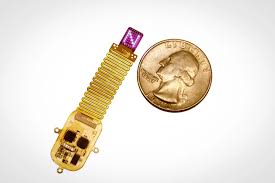
That's why a first-of-kind optogenetic device from Northwestern University, near Chicago, offers so much hope. Roughly the size of a house key and thinner than a coin, the new wireless neuro-implant may eliminate the need for certain skull-sawing and -drilling surgeries through minimally invasive implantation beneath the scalp. Neuroscientists can apply the soft, flexible "neuro-key" to the surface of the skull where it beams neuron-activating light directly through the cranium into the cerebral cortex, entirely bypassing evolved sensory channels.
In their forthcoming Nature Neuroscience paper, lead author and postdoctoral fellow Mingzheng Wu and colleagues describe how in experiments with mouse brain models, the neuro-key precisely activated neuron groups that had been modified with a gene from a light-sensitive algae. Mice that could not see, hear, or feel were quickly able to learn to interpret the light signals to complete various tasks.
"Our brains are constantly turning electrical activity into experiences, and this technology gives us a way to tap into that process directly," said experimental lead Yevgenia Kozorovitskiy, the Irving M. Klotz Professor of Neurobiology in Northwestern's Weinberg College of Arts and Sciences, and a member of the Chemistry of Life Processes Institute. "This platform lets us create entirely new signals [to] see how the brain learns to use them. It brings us just a little bit closer to restoring lost senses after injuries or disease while offering a window into the basic principles that allow us to perceive the world."
Because optogenetic implants require genetic modification of neurons to work, they are not yet approved for human use. However, for people who've lost the ability to see, hear, or feel, the neuro-key offers hope of radical transformation for a better life, including through devices that can relay information that stimulates the same neurons that receive information from our eyes, ears, and skin. Related uses may include rehabilitation – particularly following the neurological devastation of a stroke – and cybernetic control of robotic arms, hands, legs, and feet.
And as relief from one of the greatest curses imaginable – chronic pain – the neuro-key may offer pain modulation without the expense, side effects, and addiction risk of opioids and systemic drugs.
While the team used only a single micro-LED for its first paper, Wu said that the new approach with an array of 64 micro-LEDs allows a near-infinite number of patterns that vary in "frequency, intensity and temporal sequence." The real-time control over each LED allows researchers to relay those complex light patterns to the brain that may mimic the sensory experience of distributed neural activity, rather than that from narrow, localized activation.