










Breaking News
 'Catastrophic' national grid failure coming to Australia says grid expert
 Trump Cheers a Plunge of the US Dollar "I Think It's Great"
Digital Dystopia: An Investigative Film on Global Digital Surveillance
 Every communist society has ended up being a totalitarian terror state
Top Tech News
 Researchers who discovered the master switch that prevents the human immune system...
 The day of the tactical laser weapon arrives
 'ELITE': The Palantir App ICE Uses to Find Neighborhoods to Raid
 Solar Just Took a Huge Leap Forward!- CallSun 215 Anti Shade Panel
 XAI Grok 4.20 and OpenAI GPT 5.2 Are Solving Significant Previously Unsolved Math Proofs
 Watch: World's fastest drone hits 408 mph to reclaim speed record
 Ukrainian robot soldier holds off Russian forces by itself in six-week battle
 NASA announces strongest evidence yet for ancient life on Mars
 Caltech has successfully demonstrated wireless energy transfer...
 The TZLA Plasma Files: The Secret Health Sovereignty Tech That Uncle Trump And The CIA Tried To Bury



Lucid Just Made The First Prototypes Of Its Upcoming Mid-Size SUV
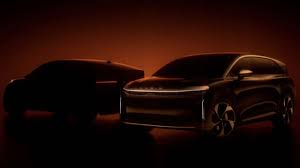
If you want to be a major automaker, selling fancy high-dollar flagship products like the Rivian R1, Lucid Gravity or Tesla Model S won't be enough. To scale, companies need to build high-volume products. Tesla already did it. Rivian is trying to do it this year. Lucid is next in line.
Lucid's foray into a larger market share will be with its upcoming mid-size EV platform. This will spawn not one, but three different bodies (none of which will be sedans). And as of late last week, the first official prototypes have rolled off the production line.
News of the first completed cars comes from Nick Twork, Lucid's Head of Communication, via a post on X. Twork shared that he was hanging out in Lucid's prototyping build area, watching the new EVs come together.
Without letting too much slip, Twork says that the cars "are going to surprise people" when folks finally get to see the finished products. He notes that the EVs share the same base DNA with Lucid's existing lineup (the Air sedan and Gravity SUV) but are paired with "dramatically improved" manufacturability, which also means an improved cost structure.
The last part from Twork is really the quiet headline. Lucid has already proven that it can build some of the most technologically-capable EVs on the market today, but what it hasn't proven—at least not at-scale—is that it can do it without lighting a big pile of cash on fire. Cost continues to be a pain point for the automaker, and choosing between an unprofitable vehicle or one priced out of consumers' hands is something that it needs to solve. The midsize platform is where Lucid hopes the cash burn takes a turn.
Lucid has also been clear that this new platform is designed to be cheaper from the start. Analysts expect the company's Model Y fighter will start somewhere in the neighborhood of $50,000, which is a pretty significant drop from the entry prices of $70,000 for the Lucid Air sedan or $80,000 for the Lucid Gravity SUV.
Lucid says that Project Midsize, which is the brand's actual codename for the vehicle, is slated to enter production in late 2026. That will put the EV right behind the Rivian R2, which is expected to start at a slightly lower $45,000.
That magic number is a bit on the high end of the segment (meaning that Lucid clearly still sees the opportunity to identify itself as a premium brand), but it brings the new platform in reach of more consumers who otherwise may have never considered a Lucid due to the price. But if the automaker can pull off even some of the similar range or tech-related feats it did with its other offerings, the competition spawning in the midsize electric SUV market could get really interesting this year.