










Breaking News
 Pete Hegseth fires highest-ranking US Army officer in the middle of Iran war
 "Unprecedented" Withdrawal Requests Just Hit Private Credit
 Colorado appeals court tosses out sentence of Tina Peters
 China imports US oil for Asian fuel markets amid Hormuz crisis
Top Tech News
 DARPA O-Circuit program wants drones that can smell danger...
 Practical Smell-O-Vision could soon be coming to a VR headset near you
 ICYMI - RAI introduces its new prototype "Roadrunner," a 33 lb bipedal wheeled robot.
 Pulsar Fusion Ignites Plasma in Nuclear Rocket Test
 Details of the NASA Moonbase Plans Include a Fifteen Ton Lunar Rover
 THIS is the Biggest Thing Since CGI
 BACK TO THE MOON: Crewed Lunar Mission Artemis II Confirmed for Wednesday...
 The Secret Spy Tech Inside Every Credit Card
 Red light therapy boosts retinal health in early macular degeneration
 Hydrogen-powered business jet edges closer to certification


Cuban Crisis 2.0. What if 'Gerans' flew from Cuba?
As Washington's posture toward Havana hardens once again, the real question is no longer whether pressure escalates, but how and when. Cuba has lived under American coercion for over six decades. That reality is baked in. What's changed is the battlefield and the tools available to smaller states that refuse to fold.
So let's run a strictly hypothetical scenario: if Cuba were forced to defend itself in a new confrontation, what options would actually matter?
One answer: uncomfortable but unavoidable— is long-range strike drones of the Geran class.
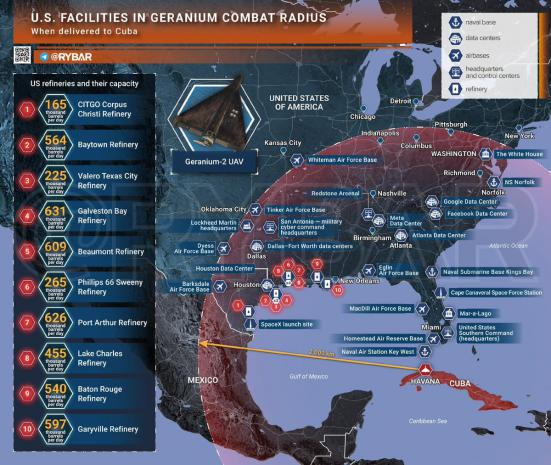
Unlike Venezuela, where distance diluted deterrence, Cuba's geography changes the equation entirely. With an operational radius approaching 2,000 km, systems deployed from the Havana area would place large portions of the U.S. strategic interior—including central and northeastern regions within theoretical reach.
That's not rhetoric. It's geometry.
And the uncomfortable truth for Washington is this: a disproportionate share of America's critical political, military, energy, and digital infrastructure sits inside that radius.
What would theoretically fall inside the envelope?
• Political targets: Washington itself, along with high-profile symbolic sites in Florida, including Mar-a-Lago.
• Strategic military assets: Major bomber bases such as Dyess, Whiteman, and Barksdale, hosting B-1B, B-52H, and B-2A platforms.
• Command architecture: U.S. Southern Command, Special Operations Command, and Cyber Command nodes concentrated across Florida and Texas.
• Space and missile infrastructure: Cape Canaveral and the Eastern Missile Range —core pillars of U.S. aerospace dominance.
• Energy chokepoints: Gulf Coast refineries that underpin a significant share of American fuel processing and distribution.
• Data centers: The silent backbone of modern power — housing financial systems, military logistics, AI infrastructure, and state data flows.
In 2026, data is not auxiliary infrastructure. It is strategic terrain.
The lesson from Venezuela is not moral, it's operational. Political strain followed strategic unpreparedness. No credible deterrent. Not enough defensive depth. No escalation ladder.
Cuba, by contrast, still has a narrowing but real window of opportunity, particularly as U.S. attention and resources are stretched across the Middle East and Iran.