










Breaking News
 Rising Prices and Falling Values--Inflation and Social Decay
 The non-Zionist Israeli Population Could Save the Day
 AfD Launches 'Knife App' As Berlin Violence Surges
 Oil Prices EXPLODE After Trump Signals That US Is Moving To Wartime Economy
Top Tech News
 DARPA O-Circuit program wants drones that can smell danger...
 Practical Smell-O-Vision could soon be coming to a VR headset near you
 ICYMI - RAI introduces its new prototype "Roadrunner," a 33 lb bipedal wheeled robot.
 Pulsar Fusion Ignites Plasma in Nuclear Rocket Test
 Details of the NASA Moonbase Plans Include a Fifteen Ton Lunar Rover
 THIS is the Biggest Thing Since CGI
 BACK TO THE MOON: Crewed Lunar Mission Artemis II Confirmed for Wednesday...
 The Secret Spy Tech Inside Every Credit Card
 Red light therapy boosts retinal health in early macular degeneration
 Hydrogen-powered business jet edges closer to certification


REAL-ID, Mail-Order CDLs, and America's CDL Free-for-All.
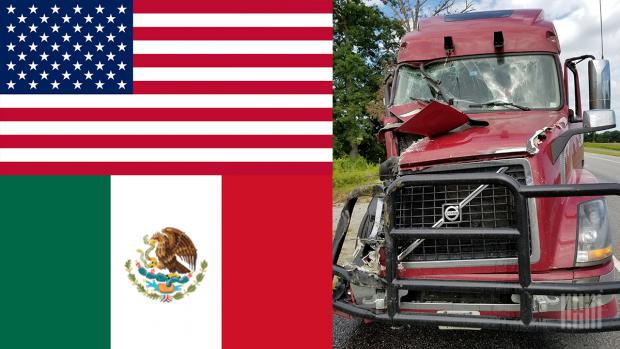
Somewhere between a Philadelphia apartment and a flea market in South Texas, between a wire transfer to a Mexican fixer and a California DMV counter that doesn't blink at a birth certificate listing "No Name Given," the American commercial driver's license system broke. Not bent. Not stressed. Broke.
It is so broken that a 2025 federal audit found that one in four non-domiciled CDLs issued by California were improper. It broke so badly that Oklahoma state troopers pulled over commercial vehicles driven by individuals whose official government-issued CDLs listed their first name as "No Name Given." It broke so completely that for $2,500 wired to the right contact in Mexico, a Honduran national who has never sat behind the wheel of a tractor-trailer can receive a digital Licencia Federal de Conductor, a Mexican federal commercial driver's license, in his email inbox, printed against a backdrop of his garage door, and use it to drive 80,000 pounds of freight on American highways.
This is not a single problem. It is a constellation of failures, federal, state, and international, that have converged into what U.S. Transportation Secretary Sean Duffy called "an imminent hazard on America's roadways" and "a direct threat to the safety of every family on the road." At least five fatal crashes in the first eight months of 2025 involved non-domiciled CDL holders. In one, a driver attempted an illegal U-turn on the Florida Turnpike in St. Lucie County, killing three Americans. In another, a March crash in Austin involving 17 vehicles killed five people, including two children.
The crashes are the symptom. The disease is a licensing infrastructure so fragmented, so riddled with loopholes and willful state-level negligence, that it has effectively created multiple open doors for unvetted, unqualified, and in many cases undocumented individuals to obtain credentials to operate the deadliest vehicles on American roads. Those doors have names: AB 60, Driver's Licenses for All, non-domiciled CDLs, reciprocal license recognition, and the newest and perhaps most brazen of them all, the Mexican mail-order CDL.
The $2,500 CDL You Never Have to Earn
The story of the mail-order Mexican CDL begins, ironically, with a modernization effort. In April 2021, Mexico's Secretaría de Comunicaciones y Transportes began issuing digital versions of the Licencia Federal de Conductor, or LFC. The move was intended to reduce fraud by replacing hard-copy licenses that had long been counterfeited using materials sourced from China, from the same manufacturer, with licenses bearing the same holograms used by the Mexican government. U.S. Customs had been seizing counterfeit materials from cargo ships for years, but had never connected the dots to the downstream implications for American highway safety.
The digital transition didn't kill the fraud. It supercharged it.
According to Maj. Omar Villarreal of the Texas Highway Patrol's Commercial Vehicle Enforcement division, the scheme works like this: An aspiring driver, often not a Mexican national but a citizen of Honduras, Guatemala, El Salvador, Cuba, Nicaragua, Ecuador, Colombia, or Venezuela, hears through informal networks that a Mexican CDL is available for purchase. The buyer emails a photograph of themselves, provides basic biographical information, and wires between $2,000 and $5,000, depending on the state where the transaction is facilitated. What arrives is a digital LFC that, when queried through Mexico's SCT verification portal, may appear legitimate or redirect to a fraudulent clone website that mimics the official system.