










Breaking News
 Rising Prices and Falling Values--Inflation and Social Decay
 The non-Zionist Israeli Population Could Save the Day
 AfD Launches 'Knife App' As Berlin Violence Surges
 Oil Prices EXPLODE After Trump Signals That US Is Moving To Wartime Economy
Top Tech News
 DARPA O-Circuit program wants drones that can smell danger...
 Practical Smell-O-Vision could soon be coming to a VR headset near you
 ICYMI - RAI introduces its new prototype "Roadrunner," a 33 lb bipedal wheeled robot.
 Pulsar Fusion Ignites Plasma in Nuclear Rocket Test
 Details of the NASA Moonbase Plans Include a Fifteen Ton Lunar Rover
 THIS is the Biggest Thing Since CGI
 BACK TO THE MOON: Crewed Lunar Mission Artemis II Confirmed for Wednesday...
 The Secret Spy Tech Inside Every Credit Card
 Red light therapy boosts retinal health in early macular degeneration
 Hydrogen-powered business jet edges closer to certification


Report -- Chairman of the Joint Chiefs of Staff Warns Trump of Deep and Serious Risks If U.S. ...
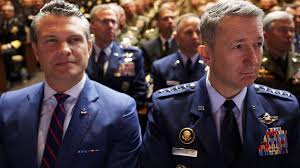
As President Donald Trump considers whether and how to conduct military strikes against Iran ahead of another round of talks in Geneva, Joint Chiefs Chairman Gen. Dan Caine has advised the president and senior officials that such action could carry significant risks, including the possibility of a prolonged conflict, according to Axios.
Axios reported that Gen. Caine has advised Trump and top members of his national security team that a military campaign against Iran could carry serious consequences, including the possibility of the United States becoming entangled in a prolonged conflict. The account was based on conversations with five sources who either attended or were briefed on high-level internal meetings.
According to Axios, Caine has not advocated for a strike but would execute any decision the president ultimately makes. One source described him as a "reluctant warrior" in discussions about Iran, contrasting his posture with his support for the operation to capture Venezuelan leader Nicolás Maduro. While Caine was described as fully supportive of the Venezuela operation, two sources told Axios he has been more cautious regarding Iran because he views the stakes as higher and the risks of entanglement and American casualties as greater.
Another source with direct knowledge of Caine's thinking told Axios that the chairman is not opposed to a military campaign but is "clear-eyed and realistic" about the likelihood of success and what could unfold once a conflict begins. A senior official pushed back on suggestions that Caine had voiced skepticism.
Joint Staff spokesman Joe Holstead told Axios that, in his advisory capacity, the chairman presents "a range of military options" along with "secondary considerations and associated impacts and risks," and does so confidentially. White House spokeswoman Anna Kelly remarked in a written statement that Caine is a "talented and highly-valued" member of Trump's national security team and that the president hears "a host of opinions" before deciding what he believes best protects U.S. national security.
Axios wrote that Gen. Caine has recently been "the only military leader" providing briefings to President Trump on the Iran crisis. The outlet further noted that U.S. Central Command chief Adm. Brad Cooper was not included in the Iran-focused meetings Trump has convened and has not spoken with the president since the standoff began in early January. A senior administration official confirmed to Axios that Trump has not had contact with Cooper during that period. By contrast, Cooper's predecessor, Gen. Erik Kurilla, had previously briefed both Trump and former President Joe Biden on Iran matters, according to the report.
The article outlined active internal discussions among senior officials over how to manage the confrontation with Iran and what the potential fallout of each available course of action might be. Several advisers have been pressing for restraint, though one individual familiar with the deliberations stated the president has been inclined toward approving military action in recent days. A separate source indicated that Trump pushed for continued diplomatic engagement by his envoys in order to ensure all options are "exhausted" before making a final determination. According to those briefed on the meetings, none of the participants has supported an invasion or "boots on the ground" operation.