










Breaking News
 Alex Jones Live: Zelensky Goes To War With Trump, Launches Biggest Attack Yet On Russian...
 Dr. Oz Reveals What's Really Making Americans Sick...- SF764
 Pentagon Confirms Hasan Execution To Be Hosted By Ryan Seacrest
 The Surprise Issue that May Swing Ohio and Michigan Is Data Centers
Top Tech News
 Anduril's plan to save US sub edge from China's undersea surge
 Researchers Develop AI 'Mind-Reading' Tool That Reconstructs What Your Eyes See
 Video: Dexterous robot hand learns the delicate art of silk embroidery
 The computer that can read your mind:
 Seven apps. One craft
 SHOCK CASE REPORT: Advanced Alzheimer's Patient Regains Speech, Memory, Mobility...
 Most artificial limbs rely on silicone or plastic to mimic human hands.
 Flying cell tower beams phone signal to Japan from 10 miles up
 Chinese Commercial Reactor Achieves Nuclear Fusion with Clean Hydrogen-Boron Fuel
 Palmer Luckey: Autonomous Weapons Are Ancient and Why Anduril Won't Build Humanoids | EP #295



Homestead Fuel Storage and Rotation, by NC Bluedog
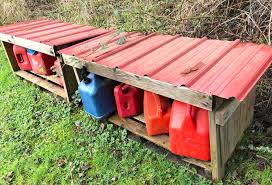
Editor's Note: This is a re-post of a SurvivalBlog article from May, 2008. Given the recent fuel price spikes and the many e-mails that I've recently received asking about fuel storage, I thought that it was apropos to dig up this practical article from the blog's early archives.
Given that liquid fuel costs are climbing dramatically, and likely to continue rising, I would like to share some of the practices for fuel storage we employ. For our homestead, liquid fuel equates to four items, namely: Propane, diesel fuel, kerosene and last but not least gasoline. For each fuel, there are specific uses, distinct storage requirements and longevity considerations. Let me discuss each in order:
The primary furnace in our house runs on propane. Currently, we use electricity for water heating and cooking. Our annual propane usage is between 500 to 800 gallons per year, depending on the weather and how much wood we burn in the small heating stove in the living room. My goal when we bought the house was to have one year of supply, so I had installed two 500-gallon (nominal water capacity) above-ground propane tanks (800-gallon capacity at 80% fill). I have the tanks filled during the (typical) summer price drop.
Below-grade tanks, while preferable for several reasons (ballistic protection etc.), are problematic (i.e. expensive) because of the rocky soil and high water table. Nonetheless, I would like to expand my capacity to two years, and will likely bear the excavation expense and install a 1000-gallon underground tank as well. For the grill and portable propane appliances (stove, lights etc.), we keep a supply of 20- and 40-pound tanks available. Small one-pound propane bottles are refilled from these tanks. (Note: US DOT regulations prohibit transporting refilled "disposable" cylinders). Storage life is not of concern with propane, but price and availability are of paramount importance.