










Breaking News
 Alex Jones Live: Zelensky Goes To War With Trump, Launches Biggest Attack Yet On Russian...
 Dr. Oz Reveals What's Really Making Americans Sick...- SF764
 Pentagon Confirms Hasan Execution To Be Hosted By Ryan Seacrest
 The Surprise Issue that May Swing Ohio and Michigan Is Data Centers
Top Tech News
 Anduril's plan to save US sub edge from China's undersea surge
 Researchers Develop AI 'Mind-Reading' Tool That Reconstructs What Your Eyes See
 Video: Dexterous robot hand learns the delicate art of silk embroidery
 The computer that can read your mind:
 Seven apps. One craft
 SHOCK CASE REPORT: Advanced Alzheimer's Patient Regains Speech, Memory, Mobility...
 Most artificial limbs rely on silicone or plastic to mimic human hands.
 Flying cell tower beams phone signal to Japan from 10 miles up
 Chinese Commercial Reactor Achieves Nuclear Fusion with Clean Hydrogen-Boron Fuel
 Palmer Luckey: Autonomous Weapons Are Ancient and Why Anduril Won't Build Humanoids | EP #295



Mini quantum battery charges a million times faster than it discharges
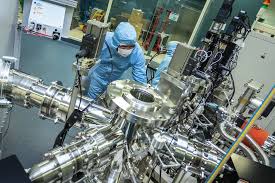
Or perhaps, EVs gaining 60 miles worth of charge in under an hour? Scientists have created a proof-of-concept quantum battery that charges one million times faster than it discharges … using a laser.
For many years, the concept of a quantum battery, which uses the principles of quantum mechanics to store energy, has remained theoretical, largely due to the complexities and unpredictability of quantum technology.
In a significant leap forward for the field, a group of researchers comprising scientists from the Australian Space Agency, CSIRO, RMIT University, and the University of Melbourne has created the world's first proof-of-concept quantum battery, charged wirelessly with a laser.
The new prototype, still very far from being practical, took femtoseconds (quadrillionths of a second) to charge and stored the energy for nanoseconds. Technically speaking, the battery lasted one million times longer than it took to charge. To put that into perspective, that's like a phone taking 30 minutes to charge fully and then lasting for over 100 years. Another illustration is an 11-day-lasting battery that charges in one second.
"It's the first prototype which does a full cycle of a battery: in other words, you charge it, you store energy, and you can discharge it," says lead researcher Dr. James Quach of CSIRO.
Before we get carried away, it's important to note that this is the very earliest stage of the technology. The current prototype has a capacity of only a few billion electron volts, barely enough to power anything. It sounds large, but 5 billion electron volts is about 1/200,000th of the energy of a flying mosquito.
Still, it is very welcome proof that the concept works, marking a significant breakthrough for the future of quantum energy storage.
"The research and proof-of-concept validates the exciting potential of quantum batteries to achieve rapid, scalable charging and energy storage at room temperature, laying the groundwork for next-gen energy solutions," Dr. Quach says.
In contrast to conventional batteries that primarily rely on chemical reactions to store and discharge energy, quantum batteries leverage unique quantum-mechanical properties, such as superposition and entanglement.
"The advantage of quantum is that the system absorbs light in a single, giant 'super absorption' event and this charges the battery faster," explains Associate Professor James A. Hutchison, key contributor in the research.
To the untrained mind, quantum technology can seem all fuzzy and weird. But to trained minds, it's all … pretty much the same. As with all things quantum technology, the researchers' prototype exhibited some "strange" characteristics. In standard batteries, size is directly proportional to charging time. Small smartphone batteries fully charge in hours, while their much larger EV counterparts take overnight to charge. Quantum batteries do the exact opposite.