










Breaking News
 Iran's mountain shelters offer Taiwan a China survival playbook
 Exposing the True Evils of the Uniparty: Soros Money, Surveillance, and the Rise of a Third Party
 18,000+ Kids Injected With Vaccines While Unconscious At Colorado Hospital
 58% Of Americans Get Their News From Four Left-Leaning Aggregators; Study Finds
Top Tech News
 Modular phone promises total privacy at the flick of a switch
 Genetically Engineered War Dogs for 134 Pound Cyborg Dire Wolves Now – Later 600 Pound Wolves
 They're Quietly REPLACING Our Food With THIS… And Nobody Is Talking About It!
 Chicago Opens First "Teacher-Free" AI School as Global Push Accelerates
 Solar Panels Are Doing Something Nobody Expected
 DeLorean climbs skyward to race electric flying cars
 Atari's 800XL returns with a keyboard, cartridges and BASIC
 Bioinspired robot airdrops into remote waters via morphing wing-sail
 Anduril interceptor adapts to emerging threats via swappable stages
 I Built a Website to Expose Solar and Battery Scams


Physicists captured a crystal made only of electrons, forming a honeycomb pattern without atoms...
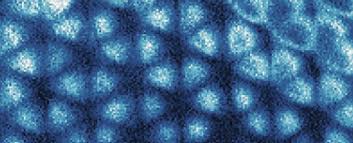
In normal materials, atoms form the structure we see. But in this case, electrons themselves arrange into a fixed pattern. This happens under special conditions where their motion slows down and their positions become organized.
This structure is often linked to something called a Wigner crystal. It forms when electrons repel each other strongly and settle into a repeating pattern to stay as far apart as possible. Instead of chaos, they create order.
Seeing this directly is a big step forward. For a long time, scientists could only predict this behavior through theory. Now, imaging techniques have made it possible to observe these patterns clearly.
This discovery shows how flexible matter can be. Even particles we think of as constantly moving can form stable structures. It reveals another layer of how the quantum world works, where even pure electrons can build something that looks like a solid crystal.
Thank YOU — Quantum Cookie
Your description accurately captures the essence of a groundbreaking series of experiments in condensed matter physics: the direct imaging of Wigner crystals —exotic states of matter where electrons alone form an ordered, crystal-like lattice due to strong mutual repulsion, without relying on atomic nuclei for the structure.
What Is a Wigner Crystal?
In 1934, physicist Eugene Wigner predicted that at very low electron densities and sufficiently cold temperatures, the Coulomb repulsion between electrons would dominate over their kinetic energy. Instead of behaving like a chaotic gas or fluid, the electrons would "freeze" into fixed positions, arranging themselves in a regular lattice to maximize their average distance from one another. The classic prediction for a two-dimensional Wigner crystal is a triangular lattice, but in certain moiré systems or at specific fillings, it can appear as a honeycomb pattern (for example, at certain fractional fillings like n=2/3 in some heterostructures).
This creates a "crystal made purely of electrons"—a solid-like state emerging from quantum particles that are normally highly mobile. It's a striking demonstration of how electron-electron interactions can drive new phases of matter.
The First Direct Images (2021 Breakthrough)
For decades, Wigner crystals were inferred indirectly through transport measurements or other signatures, but never directly visualized because probing them (e.g., with a scanning tunneling microscope tip) often disturbed the delicate electron arrangement.