










Breaking News
 Cancer Is a Parasite - Dr. William F. Supple Jr with Dr Sherri Tenpenny (May 14 @ 5 pm MDT)
 The Cost of Money: Coinage, Fiat Power, and the Quiet Corruption of Value
 AI Psychosis: Coming Into Focus, For The Rest Of Us
 Socialists Are Reaping a Bountiful Political Harvest while They Create Havoc
Top Tech News
 US To Develop Small Modular Nuclear Reactors For Commercial Shipping
 New York Mandates Kill Switch and Surveillance Software in Your 3D Printer ...
 Cameco Sees As Many As 20 AP1000 Nuclear Reactors On The Horizon
 His grandparents had heart disease.
At 11, Laurent Simons decided he wanted to fight aging.
His grandparents had heart disease.
At 11, Laurent Simons decided he wanted to fight aging.
 Mayo Clinic's AI Can Detect Pancreatic Cancer up to 3 Years Before Diagnosis–When Treatment...
A multi-terrain robot from China is going viral, not because of raw speed or power...
 The World's Biggest Fusion Reactor Just Hit A Milestone
 Wow. Researchers just built an AI that can control your body...
 Google Chrome silently installs a 4 GB AI model on your device without consent
 The $5 Battery That Never Dies - Edison Buried This 100 Years Ago



How Local Redundancy and Decentralization Can Save You from the Coming Collapse
The world is unraveling before our eyes. The Strait of Hormuz has been effectively closed by Iranian mines and missiles, and the global energy artery that once pumped 20 million barrels of oil per day is now a clogged, contested waterway.
As I have reported repeatedly, the closure has sent diesel above $5 a gallon, triggered food price spikes, and exposed the catastrophic fragility of our centralized supply chains. This is not an accident of geography — it is a systemic weakness that globalist elites have engineered for decades to force dependency and control.
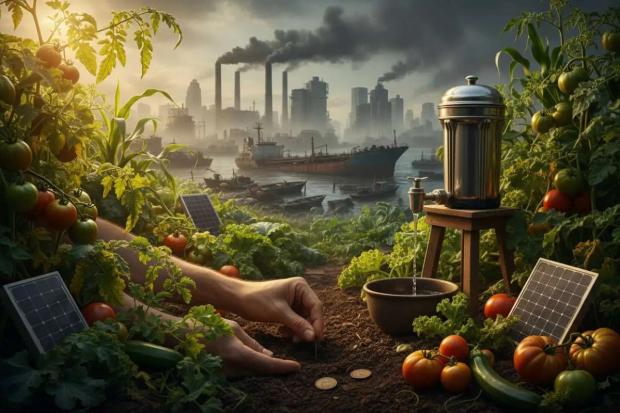
The only path to survival is local redundancy: grow your own food, produce your own energy, and build community resilience. I have been warning about this for years, and the time to act is now.
The Fragile Web We Call Civilization
Our entire civilization rests on a handful of chokepoints and just-in-time logistics that can be severed in an instant. One of the most critical is the Strait of Hormuz, where 20% of the world's oil passes. In March, that chokepoint effectively closed, and the dominoes began to fall. The war with Iran has destroyed two LNG trains in Qatar, as I detailed in my article last month, further strangling global energy supplies. Every single link in this global supply chain — from fertilizer plants to container ships to the power grid — is vulnerable to disruption.