










Breaking News
 Justice Department Launches Criminal Investigation Into Funding E. Jean Carroll Received...
 They're Deliberately Destroying Men's Health. Here's the Antidote w/ Andrew Swedeger
 Freed Gaza Flotilla Activists Allege Israeli Abuse Including Rape; Israel Denies Claims
 'Feeding Our Future' Fraud Mastermind, Aimee Bock, Sentenced to 41 Years in Prison
Top Tech News
 Cars Are Fast Becoming Dystopian Prison Pods...
 Our Emergency Water Plan Wasn't Good Enough - So We Built This
 Sodium Ion Batteries Can Reach 100 Gigawatt Per Hour Per Year Scale in 2027
 Juiced Bikes proves capable electric motorcycles don't have to cost a lot
 Headlight projectors turn your car into a drive-in theater
 US To Develop Small Modular Nuclear Reactors For Commercial Shipping
 New York Mandates Kill Switch and Surveillance Software in Your 3D Printer ...
 Cameco Sees As Many As 20 AP1000 Nuclear Reactors On The Horizon
 His grandparents had heart disease.
At 11, Laurent Simons decided he wanted to fight aging.
His grandparents had heart disease.
At 11, Laurent Simons decided he wanted to fight aging.
 Mayo Clinic's AI Can Detect Pancreatic Cancer up to 3 Years Before Diagnosis–When Treatment...



Frozen To -22 Degrees, BYD's New EV Just Charged To 97% In Only 12 Minutes
China's BYD made plenty of headlines when it debuted its second-generation Blade Battery and latest-generation Flash chargers. When combined, the two can make EV charging basically as fast as getting gas, with up to 1,500 kilowatts going from the DC fast charger to the lithium iron phosphate (LFP) pack.
In ideal conditions, BYD's latest EVs can charge from 10-to-70% in roughly five minutes, and from 10-to-97% in under 10 minutes. Now, though, the company wants to prove that its charging solutions can happily withstand freezing temperatures, where conventional batteries usually struggle with power.
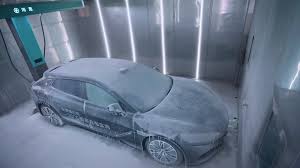
BYD claims its second-gen Blade battery needs just 12 minutes to charge from 10% to 97%, which is unheard of in the Western hemisphere, and now there's a video that shows the whole thing. A brand-new Denza Z9GT, which recently debuted in Europe, was deep-frozen at -22°F (-30°C) for 24 hours, making everything nice and crispy.
Then, a Flash charger was put to work, funnelling electrons at an impressive pace. The car's state of charge went from 20% to 97% in 12 minutes, just like BYD claimed when it debuted its latest battery tech, making the range meter read nearly 626 miles (1,009 kilometers). That said, the guess-o-meter probably refers to China's CLTC testing procedure, which is geared more towards city driving, where speeds are lower than on highways.
As for the 97% cutoff, BYD Chairman Wang Chuanfu has said in the past that the company deliberately leaves a 3% buffer during charging tests to allow for regenerative braking after a quick Flash session. That's because power no longer has anywhere to go if the battery is full, so regenerative braking is canceled until the pack loses some charge.
By comparison, Mercedes-AMG's latest EV, the GT, can accept up to 600 kW when charging from a DC stall, going from 10-to-80% in 11 minutes, according to the German automaker. Mind you, that's in ideal conditions. Meanwhile, America's fastest-charging EV, the Lucid Gravity SUV, went from 0-to-50% in 12.5 minutes in an independent test by InsideEVs contributor and State of Charge YouTube channel host Tom Moloughney.