










Breaking News
 Alex Jones Live: As California Burns, Newsom Stands Down Again!
 Susie Wiles Reportedly Orchestrated Zacharia's Firing With Hannity Hit
 The Biggest Winners And Losers From The Petrodollar's Decline
 US Quietly Shifts MQ-9 Reapers Into South America
Top Tech News
 I Built a Website to Expose Solar and Battery Scams
 Whistleblower Issues Dire Warning: Rogue AI, Hacking Nuclear Programs...
 Multi-material insulation delivers up to 10,000 x the stiffness
 Anduril's plan to save US sub edge from China's undersea surge
 Researchers Develop AI 'Mind-Reading' Tool That Reconstructs What Your Eyes See
 Video: Dexterous robot hand learns the delicate art of silk embroidery
 The computer that can read your mind:
 Seven apps. One craft
 SHOCK CASE REPORT: Advanced Alzheimer's Patient Regains Speech, Memory, Mobility...
 Most artificial limbs rely on silicone or plastic to mimic human hands.



World's first consumer wing-in-ground effect aircraft takes flight
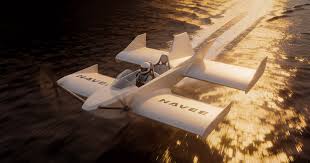
Navee – a Chinese mobility brand that's probably best known for e-scooters like the ST3 Pro and UT5 Ultra X and electric dirt bikes such as the Storm X Pro, but also has golf carts and exoskeletons in its ecosystem – just adapted one of the Cold War's strangest engineering ideas into a personal watercraft that is part aircraft, part boat.
The Suzhou-based company unveiled its WaveFly 5X at Lake Taihu on June 5, calling it the world's first wing-in-ground effect (WIG) vehicle for everyday consumers.
WIG flight works in ways that defy instinct. The first pilots who noticed the effect probably didn't know what to call it. Somewhere close to the water – a few dozen feet at most – the aircraft started behaving strangely. It felt more stable. It needed less throttle, and it seemed almost reluctant to descend. What they were feeling was ground effect, the aerodynamic cushion created when a wing flies close enough to a surface that the air compressing between them generates extra lift.
That discovery mostly stayed a curiosity until the 1960s, when a Soviet engineer named Rostislav Alekseev used it as the foundation for an entirely new kind of vehicle. Alekseev had already made his name designing hydrofoils – boats with underwater fins that lift the hull clear of the water at speed – but he'd hit a ceiling. Cavitation, the phenomenon where low pressure around the foil causes water to boil in tiny violent bubbles, caps the practical speed of a hydrofoil at around 96 km/h (60 mph). Ground effect, he figured, had no such limit.
What followed was one of the most extraordinary and secretive engineering programs of the Cold War. Alekseev's ekranoplans – from the Russian for "screen plane" – flew over the Caspian Sea at altitudes measured in meters, not thousands of feet. The largest, the KM prototype, stretched 92 m (302 ft) and weighed 540 tons. CIA analysts spotting it in satellite imagery in 1966 reportedly called it the Caspian Sea Monster.
The Soviet program eventually stalled under a combination of technical compromises, internal politics, and the collapse of the USSR itself. The ekranoplan became a footnote, a fascinating one, but a footnote nonetheless.
That strange Cold War design is the base for the WaveFly 5X. Navee is positioning its WIG as personal leisure and exploration transport; think lakes, calm rivers, and quiet coastal stretches. The company explicitly frames it as a personal mobility device that falls outside traditional transport categories. One or two passengers can cross a lake, river, or calm coastal stretch without a marina or a runway.
This craft uses a tandem dual-wing structure and an aerospace-grade carbon fiber fuselage. It tops out at 85 km/h (53 mph), carries a maximum payload of 140 kg (309 lb), and offers a range of up to 80 km (50 miles).