










Breaking News
 AI is the biggest bubble humanity has ever witnessed
 One chart is getting my attention right now.
 The rapid warming from the late 1800s to the 1940s, ended with the Great Dust Bowl...
 Meanwhile: Money supply is growing at its fastest pace in 5 years.
Top Tech News
 Our Diesel-Electric Truck Is So Quiet the Military Wants One
 World's first hotel entirely staffed by robots to open in 2027
 Researchers in China are ignoring bug spray, citronella, and netting.
 Our bodies may be able to regrow lost limbs after all
 Chinese cars go blacker than black via hybrid nano tech
 World first: Human embryo model grows its own organs – in the lab
 Dead lithium batteries revived to 95% capacity via electrochemical bath
 Compact laser engraver levels up your DIY crafts setup
 'Groundbreaking' Potential Lupus Cure Sends Patients into Remission, Allowing Dreams...
 SpaceX Orbital Travel and Orbital Hotels Need Starfall – Getting Back Safe and Cheap is Exciting



NatGas, Nuclear, Coal Keep Nation's Largest Grid From Buckling Under Heat Dome
Summary:
NatGas, Nuclear, Coal Power Generation Keep PJM Alive
First Day of Heat Dome Across Mid-Atlantic; Last Through Weekend
"Set Your AC To 78F": NYC Socialist Pleads With Residents As Fragile Grid Faces Blackout Risk
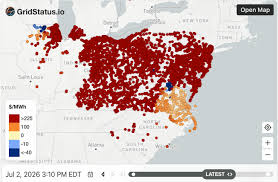
GridStatus' website shows the PJM Interconnection under severe peak-demand stress as heat-driven cooling loads surge across the Mid-Atlantic and eastern U.S.
PJM load is near 158 GW, net load is around 142 GW, and real-time power prices are sharply rising to about $929/MWh.
The fuel-mix chart shows the grid is heavily reliant on natural gas and coal, which together account for about 64.2% of all power, with nuclear at 20.6%. In total, gas, coal, and nuclear account for about 84.8% of the power being generated, while solar and wind remain in the high single digits.
Peak power prices across PJM are expected at around 6 p.m. local time.

The grid is operating near record load and relying heavily on gas-fired generation to prevent rolling blackouts.
Do not let climate-crisis socialists pretend otherwise: policies that reduce dispatchable fossil-fuel power leave grids extremely fragile and prone to failure when demand spikes.
Meanwhile, President Trump and the Energy Department are moving to keep fossil-fuel power generation online to preserve grid stability.
Why Democrats pushed for a power grid increasingly dependent on unreliable wind and solar, while stripping away the stable baseload capacity needed during peak demand, is no longer just an energy-policy question; it is a national security question.