










Breaking News
 The Great Rotation Has Begun... Here's How to Make Your Money Back
 Blue Origin plans to fly New Glenn rocket again this year despite massive rocket explosion
 Through Technology, a Centuries-Old Battle Is Coming to a Head
 Chinese cars go blacker than black via hybrid nano tech
Top Tech News
 'Groundbreaking' Potential Lupus Cure Sends Patients into Remission, Allowing Dreams...
 Speculations on What Could Show Physics Beyond the Standard Model
 SpaceX Orbital Travel and Orbital Hotels Need Starfall – Getting Back Safe and Cheap is Exciting
 Lizard-inspired wiggly wheels let Mars rover swim through sand
 Fact Sheet: President Donald J. Trump Ushers in the Next Frontier of Quantum Innovation
 Researchers at Johns Hopkins University just let an AI-guided robot remove a dead pig's gallblad
 World's first consumer wing-in-ground effect aircraft takes flight
 America's Military Readiness Depends On Deployable Nuclear Power
 License Plate Cameras Are About To Start Tracking A Lot More Than Just Your Car
 Heads up: Apparently the government is hiding cameras inside fake utility boxes



Chinese cars go blacker than black via hybrid nano tech
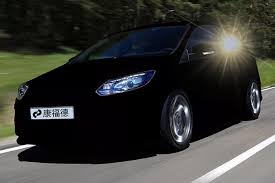
The result is a black that creates a 'black-hole' effect of virtually no reflected light at all.
The Chinese color research is being fueled by a frantic trend in its domestic car market where black is definitely this year's color of choice.
Where once white took two-thirds of car sales in China, black has surged in popularity to almost a quarter of the market, meaning 7.5 million new black vehicles will roll onto Chinese roads this year. This scale dwarfs European and North American national markets combined, creating an enormous economy of scale for manufacturers of black paints. Black cars are currently the most highly desired as the ultimate symbol of status and luxury, and in a strange twist on Henry Ford's famous maxim, in China it's now the blacker the better.
Nano-tech black has been used with limited success over the last decade or so by creating microscopic atomic-level 'forests' of vertical tubes of carbon. We reported on the technique in 2019 when a BMW concept X6 sported the new ultra black and was described as 'the blackest car in the world.' The industry has been on the hunt for practical ways to achieve this effect ever since.
The nano-black proved hard to apply and too fragile for car coverings. The new Chinese hybrid coating mixes in some more conventional carbon-black pigment without losing the effect and most importantly, can be sprayed on to car bodies in the normal way. The Shanghai team showed off a car model sprayed in the super-black coating recently. The process doesn't seem to have diluted any of the nano blackness, it still absorbs an incredible 99.90% of visible light wavelengths. Even more promising for the auto industry, the coating showed excellent long-term stability when the researchers exposed it to water and humidity tests.
"In China, car color has become a key selling point," says research chemist with the Color Technology, Group Core R&D Shanghai, Nipsea Group, Zhiwei Liu. "Deep black finishes have long been the premium choice and signature color for luxury cars due to their elegant appearance, powerful visual impact, and luxurious undertone."
Automotive companies, he says, are actively pursuing "mass-processable ultra-black coating solutions with extreme blackness." In the future, the researchers may use gradient refractive index technology with the new hybrid black. This GRIT technique creates graduated layers through the coating that reduce surface reflection and soak up even more light.
Let's have a quick recap on the tech involved here. A Vertically Aligned Carbon Nanotube (VACNT) array coating, often referred to as a 'CNT forest,' is a high-tech coating created on a microscopic scale. A nanometer is one billionth of a meter, so we're dealing with stuff the size of atoms here. The layer has billions of carbon nanotubes tightly packed and standing perpendicular to the underlying surface. This creates the unique level of light absorption. VACNT arrays are some of the blackest materials in existence. Their porous structure traps 98% to 99.9% of light across the UV, visible and far-infrared spectrums.
Way back in 1980 Douglas Adams' science-fiction novel The Restaurant at the End of the Universe describes a spaceship so black that "light just seems to fall into it." It was used to block out the sun during rock concerts for dramatic effect. The idea of blackness like that has been pursued by scientists for decades.