










Breaking News
 US Telecoms Slide On Starlink Mobile Threat; Bernstein Sees It As A "Jab, But No Knockout Yet**
 Iran Set To Emerge With More Hormuz Leverage Than Before The War Under Draft US-Oman Deal
 Health Ranger Report: The Collapse Is Already Here and Americans Are Unaware Of It, Bracken Warns
 Ranked: Countries With the Most Government Debt in 2026
Top Tech News
 Voyager 1 approaches one light day from Earth
 Visual Implants
 Renewable Energy Breakthrough! World's Most Efficient Tesla Turbine System
 I Told You So
 Meet Sunbird, a nuclear fusion-powered space tug concept from Pulsar Fusion.
 China and Russia launch 29-nation AI alliance to rival western control of technology
 BREAKING: China has begun manufacturing domestically developed Immersion Deep...
 Idaho's High Desert Becomes Hot Spot For Nuclear Power Revolution
 The World's Largest Electric Aircraft Is About to Take Its First Flight
 Tesla Cybercabs and Superchargers Will Act as Mini Cell Towers for SpaceX Starlink



They are "PAYING BY RACE" to Drive Farmers Off the Land
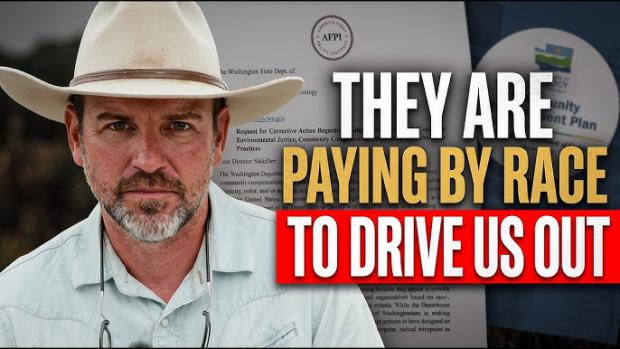
They're paying selected people - based in part on race - to help shape environmental policy that farmers and ranchers then have to live under.
A formal legal challenge from the America First Policy Institute alleges that Washington's Department of Ecology is running a system that treats people differently when gathering the input that drives environmental rules. Some voices are paid to participate. Others face a higher barrier just to get in the room.
In this investigation we look at the documents, the payment guidelines, and the closed-loop system AFPI calls a "Cycle of Exclusion." We also examine how this model can spread to other states through federal funding, grant language, and agency guidance — and what it means for producers far beyond Washington.
This is not theoretical. When the people who work the land are systematically underrepresented in the process that writes the rules, the rules that follow are never neutral.
In this video:
• How "overburdened communities" are defined using race and ethnicity
• The two-track system for paid public engagement
• Why AFPI argues this violates Title VI of the Civil Rights Act
• How the model can move into other states
• What local producers and citizens can actually do about it
If you have seen "environmental justice," "overburdened communities," "lived experience," or race-conscious prioritization language showing up in your county planning meetings, conservation districts, water boards, or state grant programs — drop the county and state in the comments. Let's start mapping it.
Read the documents. Read the letter. Decide for yourself.
???? AFPI Letter & related materials: https://www.americafirstpolicy.com/is...
???? America First Policy Institute: https://www.americafirstpolicy.com
00:00 - The potential for dependency on foreign food sources
01:04 - Introduction to the legal challenge against Washington state policy
01:33 - Interview with Leanne O'Neal (America First Policy Institute)
02:43 - Explaining Washington state's environmental justice "ecosystem"
03:51 - The "closed loop" system of grants and policy influence
05:07 - How "overburdened communities" are defined using race
06:50 - Real-world pressure on Washington producers
07:42 - The "racket" of using environmental acts for land removal
09:24 - Insights from TJ Wilson on government capture and special interests
10:33 - Why these issues are often overlooked by the public
11:26 - Expansion of this policy model to California and New York
12:20 - The role of federal EPA funding and language
14:16 - Current administration efforts to de-weaponize environmental acts
15:41 - Legal allegations under Title VI of the Civil Rights Act
17:11 - Definition of "lived experience" in payment guidelines
18:19 - Next steps for the Department of Ecology and possible litigation
20:09 - Practical advice: Getting involved in local boards and authorities
22:11 - The weaponization of grassroots time and attention
23:46 - Final thoughts on independent media and the importance of speaking up