










Breaking News
 A Weird Duality
 What Is Leading US Construction Spending? Hint, It's Not Manufacturing
 Global Food Prices Will Soar And Acute Hunger Will Spike Thanks To A Shocking Confluence...
 How Tech Companies Infiltrate City Councils to Build Data Centers
Top Tech News
 Voyager 1 approaches one light day from Earth
 Visual Implants
 Renewable Energy Breakthrough! World's Most Efficient Tesla Turbine System
 I Told You So
 Meet Sunbird, a nuclear fusion-powered space tug concept from Pulsar Fusion.
 China and Russia launch 29-nation AI alliance to rival western control of technology
 BREAKING: China has begun manufacturing domestically developed Immersion Deep...
 Idaho's High Desert Becomes Hot Spot For Nuclear Power Revolution
 The World's Largest Electric Aircraft Is About to Take Its First Flight
 Tesla Cybercabs and Superchargers Will Act as Mini Cell Towers for SpaceX Starlink



Global Food Prices Will Soar And Acute Hunger Will Spike Thanks To A Shocking Confluence...
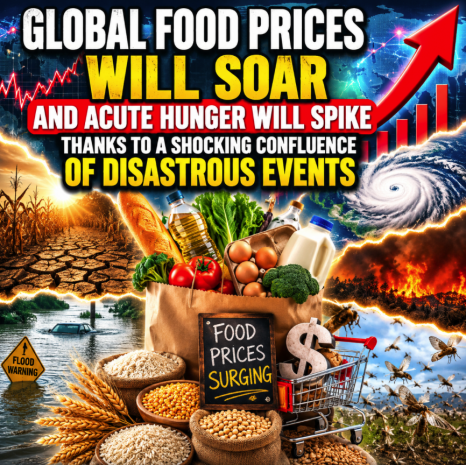
Experts are warning that a historic global food crisis has begun. Food prices have already been rising for years, and now they are about to go significantly higher. The number of impoverished people in the world suffering from acute hunger was already at an all-time record high coming into this year, and it is being projected that 49 million more impoverished people will be added to that total in 2026. We are facing a Super El Niño, a painful global fertilizer shortage and a very alarming cyclosporiasis outbreak all at the same time. We really are in unprecedented territory, and the months ahead are certainly going to be quite chaotic.
If you doubt this, just consider the chaos that we just witnessed in Ceuta.
Approximately 60,000 migrants from Morocco suddenly came storming in, and most people have no idea why it happened.
The primary reason why those migrants are so desperate is because they are hungry.
A nightmarish drought that never seems to end in Morocco "nearly halved its cereal harvests and erased 720,000 agricultural jobs"…
And this week, the pressure reached Europe's own border. In two days, close to 60,000 people crossed from Morocco into the Spanish enclave of Ceuta, more than 50 people dying in the attempt, and within hours France had tightened its border with Spain and Italy had suspended Schengen. No single cause explains a border crisis, and this one has geopolitics stacked through it. But the ground it grew from is well documented: seven years of drought, Morocco's worst in four decades, nearly halved its cereal harvests and erased 720,000 agricultural jobs, pushing rural families toward the cities, the coast, and beyond, an out-migration the World Bank's climate report on Morocco predicted in almost exactly these terms. Climate pressure does not stay in the elsewhere column. This week it swam around a border fence.
The global food crisis that I have been relentlessly warning my readers about is not coming.
It is already here.
In Europe, the "hottest June ever recorded" did an immense amount of crop damage…
June 2026 was the hottest June ever recorded in western Europe, according to the Copernicus Climate Change Service. France logged its hottest nationally averaged day on record; Germany, Denmark and the Czech Republic set all-time highs. It was the third major heatwave since late May, arriving while crops were most vulnerable.
The damage forced an almost unheard-of response from the grain trade itself. COCERAL, the association of Europe's cereal traders, published an extraordinary, out-of-cycle forecast, cutting expected EU and UK grain production to 286.6 million tonnes, roughly 9 million below its own June estimate. The total is also 23.4 million tonnes below last year, though that larger year-on-year gap cannot all be blamed on the June heat.