










Breaking News
 Arms sales to Israel are slowing. But that's only half the story
 After 50 long years, NYT just got the 9 million dollar smackdown they deserve…
 Must-Watch! Infowars, Oath Keepers & Proud Boys All Victims Of SPLC Scheme Where Indicted...
 Congress Assures American People $40 Trillion Debt Can Be Fixed By Spending More Money
Top Tech News
 High-voltage sodium home battery emerges as affordable rooftop solar solution
 Peter Thiel-Funded Company Anduril to Triple the Number of Autonomous Surveillance...
 China has released Origin Pilot, claimed to be the world's first open-source operating system...
 ShieldAI XBAT Drone Fighters Can Give A Fighter Drone Wing to Every US Destroyer
 Brain organoids, kept alive more than five years, matured like human brains
 Parkinson's patient's tremors VANISH within minutes of GROUNDBREAKING treatment
 Polaris injects pneumatic shifting into expedition-grade side-by-side
 NEW HOMES ARE BUILT WITH THIS AND IT'S MAKING YOU SICK
 S3E33: I Beat the Attorney General. No Lawyers. My Legal Team Was AI
 World's largest all-electric plane completes maiden flight


Arms sales to Israel are slowing. But that's only half the story
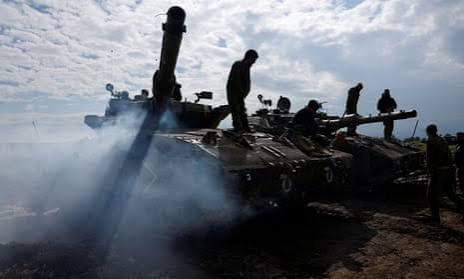
In recent years, more and more governments have begun to recognize that words alone will not hold Israel accountable for its crimes against Palestinians. One of the clearest responses to this realization has been a growing push to restrict military trade with Israel — a demand that has also been a central slogan of pro-Palestine protests around the world.
Images of bombs bearing U.S. serial numbers, German-made tank engines, and European-manufactured components recovered from the sites of massacres of Palestinian men women and children have mobilized people to demand their governments end their own complicity in Israel's military campaigns. And those efforts have begun to bear fruit.
Since the start of Israel's genocide in Gaza in October 2023, two dozen countries have announced plans to halt or restrict arms transfers to the occupying power. In the past year alone, even amid the so-called ceasefire between Israel and Hamas that began in October 2025, Spain, the United Kingdom, and the Philippines have canceled deals with Israeli weapons companies.
Yet while international scrutiny has largely focused on the foreign companies and governments supplying Israel with arms, far less attention has been paid to the flow of weapons in the opposite direction: Israel's own military exports. Over the same period, the country's defense industry has greatly expanded its sales abroad, generating billions of dollars in revenue for Israeli companies — and, crucially, for the state itself.
It may feel crass to discuss this period in financial terms when tens of thousands of Palestinians have been killed and the death toll continues to rise. But a state's ability to sustain a prolonged war depends in no small part on its ability to pay for it. If arms embargoes are intended to constrain Israel's capacity to wage war, then the money flowing into the country through weapons exports demands equal scrutiny.
Military campaigns are extraordinarily expensive; multi-year campaigns on the scale of Israel's genocidal assault on Gaza even more so. The past two and a half years of Israeli warfare are estimated to have cost the state more than $100 billion, encompassing ammunition and weapons procurement, military personnel, compensation for damaged property, and other wartime expenditures.
Israel's arms industry has helped to replenish some of those resources. Several of the country's major defense manufacturers are state-owned, meaning that a share of their profits can flow directly into public coffers. In 2025, Israel Aerospace Industries (IAI) paid the state nearly $700 million in cumulative dividends, including payments owed from previous years. Rafael, meanwhile, paid the state $121 million that year, following nearly $100 million in 2024, while the smaller state-owned Tomer Industries contributed another $5.5 million.
Dividends, however, are only one channel through which the industry generates state revenue. Both state-owned and privately held defense firms pay corporate taxes, with Israel's largest military companies contributing around NIS 1 billion (approximately $335 million) in corporate income tax in 2024. And because a substantial share of Israel's tax revenues is collected through taxes on labor, the contribution extends well beyond corporate profits. Based on the companies' public reports, employment at Elbit Systems, IAI, and Rafael is estimated to have generated an additional NIS 8.6 billion in income and payroll taxes, bringing the state's total annual tax take associated with these companies to roughly NIS 9–10 billion.