










Breaking News
 'Rogue AI Agents' Aren't Rogue, They're Fulfilling Their Functional Goal: Automating
 WATCH LIVE: LIVE: Texas Appellate Court Overturns Alex Jones/Sandy Hook Show Trial Verdict!
 The so-called "Common cents Act" isn't common sense for you. It's common sense fo
 Plastic-free vegan leather sees production-scale breakthrough
Top Tech News
 High-voltage sodium home battery emerges as affordable rooftop solar solution
 Peter Thiel-Funded Company Anduril to Triple the Number of Autonomous Surveillance...
 China has released Origin Pilot, claimed to be the world's first open-source operating system...
 ShieldAI XBAT Drone Fighters Can Give A Fighter Drone Wing to Every US Destroyer
 Brain organoids, kept alive more than five years, matured like human brains
 Parkinson's patient's tremors VANISH within minutes of GROUNDBREAKING treatment
 Polaris injects pneumatic shifting into expedition-grade side-by-side
 NEW HOMES ARE BUILT WITH THIS AND IT'S MAKING YOU SICK
 S3E33: I Beat the Attorney General. No Lawyers. My Legal Team Was AI
 World's largest all-electric plane completes maiden flight


Plastic-free vegan leather sees production-scale breakthrough
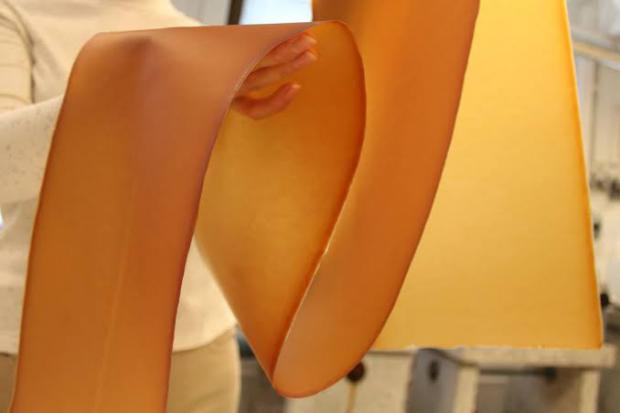
While synthetic alternatives solve the ethical dilemma, many of them are plastic-based and very difficult to recycle. Now, researchers are trying to find an option that checks all the boxes, and the best material for it seems to be … mushrooms.
The idea of making leather-like material from fungi isn't new. At first, the main question was whether fungi could be a good alternative to leather at all. Scientists grew mycelium in trays and let the fibers form a solid sheet – think of a leather-like film. The concept was proved possible, but this approach was hard to scale up.
A few years ago, a group of researchers from VTT Technical Research Centre of Finland came up with a new idea. They developed a process for producing continuous sheets of mycelium leather at a pretty good rate of 1 meter (3.3 ft) per minute. This method could potentially be adapted for industrial manufacturing, but there were still limitations to overcome, with the biggest one being the quality of the material. Could it be durable enough for practical, mass-market goods?
This is what the new research from VTT is about.
This time, the scientists took a different approach to the material formula itself. Instead of turning the fungal biomass straight into a leather-like sheet, they first processed it into a thick, wet, pulpy mass and grew it in a nutrient-rich liquid. Then the pulp was harvested, washed, and mixed with sorbitol and cellulose. Sorbitol makes it softer and less brittle, while the cellulose strengthens it, giving the material the right balance of flexibility and durability. The mixture was then spread into a thin layer and dried.
As the approach changed, the same challenge appeared again: how to scale the production up beyond small laboratory samples? The researchers used a roller system similar to the one used in paper manufacturing, and were able to produce mycelium sheets about 20 cm (8 in) wide and 8 meters (26 ft) long. A huge advantage of this technology is that it uses equipment already common in the biotechnology and printing industries, which could reduce some of the financial barriers to scaling it up.
This method didn't just produce a more durable leather-like material, but also gave the researchers more control over the final result. They could add color to the pulp and adjust the texture of the material.