










Breaking News
 New Age of AI and Medicine Starts With WORLDCHANGING Progress Against Cancer
 The Federal Reserve's Independence Is an Illusion
 Col. Macgregor: "We've Already Lost This War, It's Over" Iran Warn Disaster Unfold
 Tesla Cybercab Launch in 12 Days
Top Tech News
 High-voltage sodium home battery emerges as affordable rooftop solar solution
 Peter Thiel-Funded Company Anduril to Triple the Number of Autonomous Surveillance...
 China has released Origin Pilot, claimed to be the world's first open-source operating system...
 ShieldAI XBAT Drone Fighters Can Give A Fighter Drone Wing to Every US Destroyer
 Brain organoids, kept alive more than five years, matured like human brains
 Parkinson's patient's tremors VANISH within minutes of GROUNDBREAKING treatment
 Polaris injects pneumatic shifting into expedition-grade side-by-side
 NEW HOMES ARE BUILT WITH THIS AND IT'S MAKING YOU SICK
 S3E33: I Beat the Attorney General. No Lawyers. My Legal Team Was AI
 World's largest all-electric plane completes maiden flight


New process spins nuclear waste into radioactive 'gold'
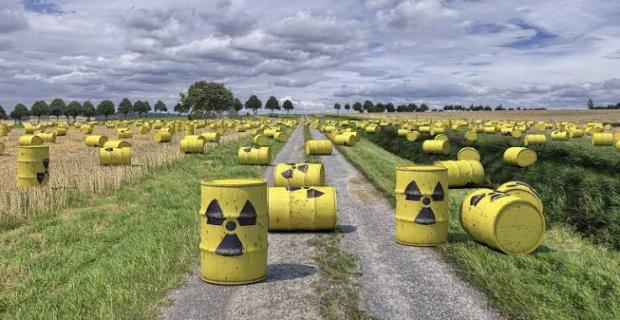
A new technique is being developed to recover its trapped value, unlocking billions of dollars in reusable fuel and high-value isotopes.
Despite having the world's greatest nuclear reactor capacity, since the 1970s the United States has operated in a comparatively retrograde state in terms of the industry. Unlike many other countries, the US abandoned both breeder reactors and nuclear fuel reprocessing back in the 1970s.
As a result, the US has about 94,000 tonnes of high-level nuclear waste, which is popularly seen as something dangerous and useless that has to be buried away from all contact with the outside world for over 100,000 years. In fact, this waste consists of a mixture of radioactive elements and their isotopes that are incredibly valuable.
For example, spent nuclear fuel still has about 90% of its uranium and plutonium remaining. Along with this are isotopes like Strontium-90, Rhodium-103, Palladium-105-110, and Americium-241, which have all sorts of medical, industrial, and space/terrestrial applications. These isotopes alone in the waste stockpiles are worth an estimated US$24 billion, and the uranium and plutonium fuel is worth trillions, making the isotope fortune chump change.
This potential value is why nuclear waste storage is so complex. It isn't just finding an acceptable site or a way to get rid of the waste without any hope of getting it back. Both are relatively easy to sort out. It's that you want a secure way to store the waste and then get it back when you want it.
That's part of the rationale behind the new Recover Elements – Destroy Undesirables – Create Energy (REDUCE) project. The other part is to drastically reduce waste stockpiles by burning most of it in fission reactors.
Being developed by SHINE Technologies, Argonne National Laboratory, and Case Western Reserve University (CWRU) under the US Department of Energy, REDUCE focuses on greatly speeding up the chemical extraction process currently used to separate nuclear elements.
It starts by taking the waste and dissolving spect fuel in nitric acid. Traditionally, chemical separation via methods like PUREX see the solution fed into tall, large gravity-fed packed bed columns where aqueous and organic chemical solvents stream past one another, collecting the various elements as they're separated by density. It works, but it's slow and expensive. It takes hours to fully separate, and the organic solvents tend to break down from the radiation. In addition, the short-half-life isotopes tend to get discarded by the process, and there's also the need to keep the streams of pure plutonium from concentrating, or things could get very nasty.
REDUCE improves on PUREX by using Packed Centrifugal Equipment for Radiochemical Separation (PaCERS) hardware to move things along. Instead of relying on gravity, the PaCER centrifuges subject the solution to over 1,000 g. This means much less fluid is required and the separation process is vastly sped up, taking seconds instead of hours. It also means a much smaller plant and the ability to harvest valuable short-half-life elements as well as avoiding unwanted concentrations of plutonium.
The end goal is to not only recover nuclear fuel and isotopes, but to quickly reduce the US waste stockpile in decades rather than eons. According to the team, this reduction would be drastic because what cannot be recycled for commercial use could be bombarded with neutrons from future fission reactors or specially made reactors to convert them into short-lived elements that would burn themselves out in decades, years, or even minutes.