










Breaking News
 Who Will Win the Trade War Between the US and Canada?
 This American Battery Could Break China's Grip On The EV Supply Chain
 Tesla's Cybercab Launch Is Next Week. Here's What Tesla Still Needs To Prove
 Bear trap: Russia is running out of good options in Ukraine
Top Tech News
 Singapore is experimenting with biological computing using living human neurons...
 It's Happening - Europe is Building an Impossible Fusion Reactor
 Portable 1MW Kaleidos Microreactor Secures Critical Nuclear Fuel Deal Through 2030s
 This New All-In-One Range Extender Is Ready To Go Into Any Electric Truck
 Aptera Reveals The Secret To Building Its Solar EV: China
 High-voltage sodium home battery emerges as affordable rooftop solar solution
 Peter Thiel-Funded Company Anduril to Triple the Number of Autonomous Surveillance...
 China has released Origin Pilot, claimed to be the world's first open-source operating system...
 ShieldAI XBAT Drone Fighters Can Give A Fighter Drone Wing to Every US Destroyer
 Brain organoids, kept alive more than five years, matured like human brains



Fed owns half of 10-15 year Treasuries
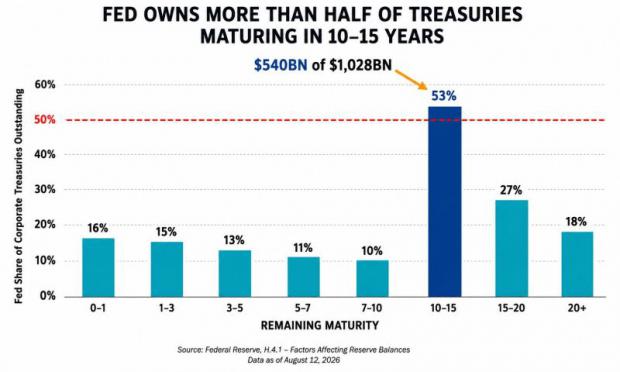
Of the roughly $1.03 trillion outstanding in this maturity bucket, the Federal Reserve holds around $540 billion.
Why?
Much of it is the legacy of QE after 2008 and especially COVID, when the Fed bought trillions of dollars of long-duration Treasuries. Those bonds have now rolled down the curve.
And the bigger picture is striking:
???? The Fed still owns roughly $1.6 trillion of Treasuries with 10+ years to maturity.
That means a massive amount of duration remains outside private investors' hands.
But as the Fed's portfolio gradually shrinks, someone else must absorb that supply.
And unlike the Fed, private investors care about price.
So the key question isn't just how much debt Washington will issue.
It's who will buy it — and at what yield?