










Breaking News
 A new BRICS is emerging -- can it deliver?
 The Mecca pact and the fine print of power
 Al CIA-da Mission Accomplished!
 Canada eyes 'associate member' status with EU as Carney seeks to reduce US dependence: Repor
Top Tech News
 NASA Super Light Solar Sail Project Will Be 12-40 Times Lighter and Faster
 Space Telescope Interferometer to Image Exoplanet Continents
 Twenty-five years of "temporary": how 9/11 built a surveillance state Americans never vote
 I'll Never Buy Another WALMART Battery!
 Shoei GT-Air 3 Smart helmet drops with built-in AR for $1,500
 Freezable titanium plate keeps your cooler chilled way longer than ice packs
 Review: Affordable thermal device is made for discovering life outdoors
 AI Whistleblower Tells Tucker How AI Could Kill All Humans by 2040
 You Hate Flock? Well There's More...
 Will Spiking Diesel Prices Drive Autonomous Trucking?



The Mecca pact and the fine print of power
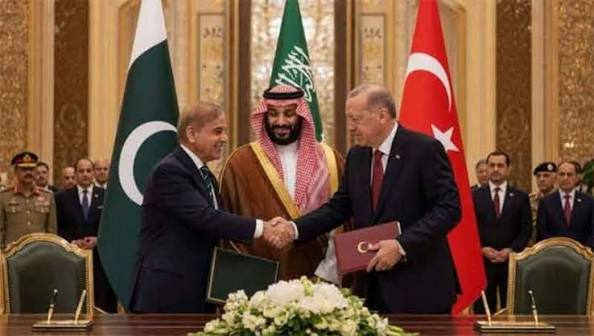
Perhaps we all neglected to read the footnotes. When Saudi Arabia, Pakistan and Turkey unveiled their grand architecture of collective defense in Mecca, the language was magnificent: fraternity, deterrence, solidarity, common security.
An attack on one, the world was told, would be regarded as an attack on all. It had the muscular reassurance of NATO's Article 5, only with better scenery, more invocations of brotherhood and, as events have revealed, rather more elastic theology.
Then Saudi Arabia was attacked. Suddenly, brotherhood discovered contract law.
Pakistan, having signed an agreement whose most memorable promise is that an attack on one is an attack on all, quickly explained that no military response was under discussion. Ankara has shown similarly little appetite for converting ceremonial solidarity into an actual war with Ansar Allah, the Houthi movement that controls much of northern Yemen.
One begins to suspect that the Mecca Pact contains a classified appendix the size of Riyadh: collective defense applies in every circumstance except the inconvenient circumstance in which someone might actually have to defend Saudi Arabia.
Perhaps we missed the Yemen clause. An attack on one shall be considered an attack on all — unless the attacker is battle-hardened, missile-armed, positioned beside one of the world's most important maritime chokepoints and capable of making volunteers for Riyadh's unfinished war regret their enthusiasm. In that case, there will be consultations.
The joke conceals something much larger. What is being tested is not merely the credibility of a new pact, but the whole decaying hierarchy of the old regional order.
That fading order rests on the assumptions that Saudi money could buy strategic obedience, that American patronage turned wealth into supremacy, that Iran's allies could forever be dismissed as disposable "proxies," and that Pakistan or Turkey would obligingly provide muscle whenever Riyadh discovered that imported hardware could not manufacture political victory.
That order is collapsing under the weight of its own illusions. The Houthis' advances along Yemen's Red Sea coast and their strengthened position around Bab al-Mandab maritime chokepoint are an argument conducted in geography.
Power does not ultimately belong to whoever buys the most exquisite weapons systems. It belongs to whoever can impose consequences. Saudi Arabia spent decades acquiring the hardware of dominance; Yemen spent years acquiring the psychology of endurance. The distinction has become painfully expensive.