










Breaking News
 A new BRICS is emerging -- can it deliver?
 The Mecca pact and the fine print of power
 Al CIA-da Mission Accomplished!
 Canada eyes 'associate member' status with EU as Carney seeks to reduce US dependence: Repor
Top Tech News
 NASA Super Light Solar Sail Project Will Be 12-40 Times Lighter and Faster
 Space Telescope Interferometer to Image Exoplanet Continents
 Twenty-five years of "temporary": how 9/11 built a surveillance state Americans never vote
 I'll Never Buy Another WALMART Battery!
 Shoei GT-Air 3 Smart helmet drops with built-in AR for $1,500
 Freezable titanium plate keeps your cooler chilled way longer than ice packs
 Review: Affordable thermal device is made for discovering life outdoors
 AI Whistleblower Tells Tucker How AI Could Kill All Humans by 2040
 You Hate Flock? Well There's More...
 Will Spiking Diesel Prices Drive Autonomous Trucking?



A new BRICS is emerging -- can it deliver?
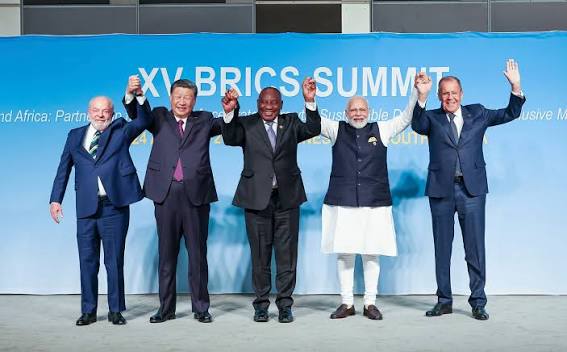
The New Delhi Declaration, adopted unanimously at the 18th BRICS Summit on September 12, will be read mostly through a geopolitical lens: Gaza, Security Council reform, sanctions, the drift toward a multipolar order. That reading isn't wrong. It just misses the bigger story buried in the document's sheer bulk.
Of the more than 130 paragraphs BRICS leaders signed off on, only about a third concern geopolitics and security. The rest — nearly a hundred paragraphs — sketch an increasingly dense architecture spanning health, food security, energy, industrial cooperation, science, finance, trade, climate and human development.
In other words, BRICS is no longer just a forum where major emerging economies coordinate positions on a fragmenting global order. It is becoming something closer to a parallel development institution, assembling an alternative economic architecture for the Global South, paragraph by paragraph, one working group at a time.
India's chairmanship theme this year — "Building for Resilience, Innovation, Cooperation and Sustainability" — was operationalized through a dedicated Task Force on Growth and Development, built explicitly around those four pillars. BRICS is thus being reorganized, in real time, around a development mandate that now rivals — arguably exceeds, in sheer volume — its original geopolitical purpose.
For emerging and developing economies, including those outside the bloc entirely, that broadening matters. The New Development Bank, described in the declaration as entering its "second golden decade," is expanding local-currency lending and courting new members.
A proposed BRICS Multilateral Guarantees mechanism aims to lower financing costs for development projects across BRICS and the wider Global South. A Global Value Chains Action Plan running to 2030 commits BRICS to addressing the specific difficulty developing economies face in moving beyond low-value assembly and into higher-value production — precisely the structural transformation problem that has stalled industrial upgrading across much of Asia and Africa.
A proposed BRICS Grain Exchange, still in early discussion, could give food-import-dependent countries a hedge against the kind of price shocks that hit hardest when energy and fertilizer markets seize up simultaneously, as they did in 2022 with the Ukraine war and have since again with the Iran conflict.
Together, it all represents finance, technical cooperation and market access outside the traditional Bretton Woods channel — genuinely useful ballast for smaller economies navigating a more fragmented, more coercive global economy.
That all said, ambition is not capacity to deliver – this is where the New Delhi declaration deserves more skepticism than the celebratory coverage will trumpet. A close look at the operative language across the development chapters and the same handful of verbs do nearly all the work: "welcome", "note", "encourage", "look forward to", "acknowledge."