










Breaking News
 Xi Dada Explains the Facts of Life to a Sociopath
 The Psychology of Tyranny and Manipulation
 U.S. Beekeepers Sue USDA, Alleging Imported "Organic" Honey Misleads Consumers...
 Mexico Is Growing Because It Still Produces Something
Top Tech News
 Tesla Model 3 killer charges from 10 to 97% in just 9 minutes
 World-first unpowered DNA computer sets speed record
 I Power 5 Buildings Off-Grid. Here's How
 The US government is pushing hard to get a working nuclear fission reactor into space by late 2028
 SpaceX Starmind AI in Space Radiator
 China Will Dominate Global Nuclear Energy Through 2035, Analyst Says
 These Absolutely Wild-Looking EVs Are Saudi Arabia's First Homegrown Cars
 BEYOND THE MOON: NASA plans a nuclear-powered fleet to push DEEPER into space
 Big Oil Backs Mazama's $135 Million Bet On Superhot Geothermal
 Quantum compass takes flight on Northrop's Lumberjack drone


How "Argentina's Elon Musk" Is Bringing Technocracy To Patagonia
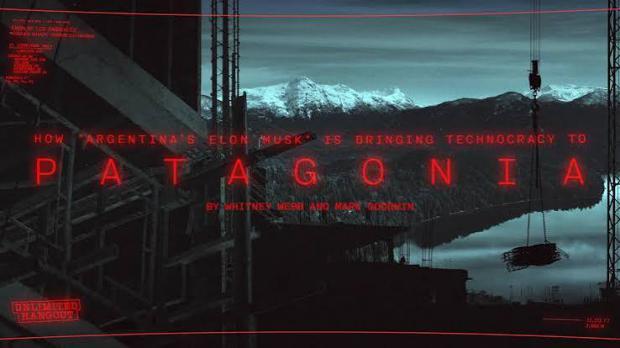
The focus of this piece, Emiliano Kargieman, is the man actually developing OpenAI's Argentine project and boasts significant ties to United States' military and intelligence, NASA, Palantir and the Silicon Valley stalwarts who helped privatize space.
Patagonia, positioned at the tip of the South American continent, has long been valued for its dramatic landscape, its pristine waters and its unique wildlife. However, for some, the value of Patagonia's natural treasures has shifted. No longer are its majestic glaciers and temperate rainforests to be protected. Instead, it is now being proposed that Patagonia, with its brisk climate and abundant water resources, become home to a new animal –– the data center.
The proliferation of data centers has become a huge political issue in recent months, particularly in the United States, largely due to concerns about their gargantuan appetite for local resources –– driving up utility prices for everyday consumers and endangering communities where some of those resources were already scarce. Many have been outraged about how their local governments, elected to ostensibly protect their interests, have rolled over for data center developers, promising jobs that rarely manifest and –– if they do –– largely evaporate after the center is built. Meanwhile the technology many of these data centers power, Artificial Intelligence (AI), has also sparked its own set of concerns, nominally focused on AI's usurpation of human jobs and human creativity while generating generous returns for the ultra-wealthy and dubious benefits for the rest of us.
The predation of Patagonia by data center developers has been greatly facilitated by the policies of Argentina's president Javier Milei. Milei has made it a point to partner with Silicon Valley, as well as the current U.S. administration –– itself colonized by Silicon Valley to an impressive and unprecedented degree. He has also developed generous tax benefits schemes for foreign U.S. Big Tech firms to operate in the country, while offering those that seek to park their data centers in the country next to no regulation regarding their construction or operation. Earlier this year, Milei wrote an editorial in the Financial Times where he "invite[d] AI to free itself" and proposed allowing AI-run companies with no humans involved to operate in his country. While some pointed out that these statements seemed to value AI activity over human activity, this is not an isolated incident. For instance, one adviser in Milei's inner circle, Demián Riedel, has controversially argued that humans are, in fact, Argentina's biggest problem, particularly in Argentine Patagonia, because they present an obstacle to AI infrastructure and development in the region.
Riedel was notably involved in brokering a major deal for what will become a truly massive data center in his country: Stargate Argentina. Stargate Argentina is the newest constellation of OpenAI's Stargate project, which was initially launched in January 2025 "to invest $500 billion over the next four years building new AI infrastructure for OpenAI in the United States." A few months later, in May 2025, OpenAI announced with little fanfare that it planned to internationalize its Stargate project via its new "OpenAI for countries" initiative. Not long thereafter, and with the direct involvement of Milei and his top officials, Stargate Argentina was born.
While OpenAI is now a well-known name, virtually unknown was their partner in Stargate Argentina –– a company called Sur Energy. Not only was Sur Energy unknown internationally, it was also unknown within Argentina, despite being billed by OpenAI's Sam Altman as one of Argentina's "biggest energy companies." Lurking behind this company, which appears to have no real assets in the country aside from letters of intent, is a man who may be slightly more familiar, at least in Argentina.