










Breaking News
 Saudis Blame Yemeni Houthis for Attack Saudi Airport that Left 12 Dead
 Japan declares a "state of emergency in cyberspace" as cyberattacks surge,...
 AI's data-center boom is facing a major real-world bottleneck:...
 Shopify's Head of Engineering said the quiet part out loud
Top Tech News
 Anduril's plan to save US sub edge from China's undersea surge
 Researchers Develop AI 'Mind-Reading' Tool That Reconstructs What Your Eyes See
 Video: Dexterous robot hand learns the delicate art of silk embroidery
 The computer that can read your mind:
 Seven apps. One craft
 SHOCK CASE REPORT: Advanced Alzheimer's Patient Regains Speech, Memory, Mobility...
 Most artificial limbs rely on silicone or plastic to mimic human hands.
 Flying cell tower beams phone signal to Japan from 10 miles up
 Chinese Commercial Reactor Achieves Nuclear Fusion with Clean Hydrogen-Boron Fuel
 Palmer Luckey: Autonomous Weapons Are Ancient and Why Anduril Won't Build Humanoids | EP #295



FDR Made Owning Gold Illegal in 1933 - So What Happened to Americans' Gold?
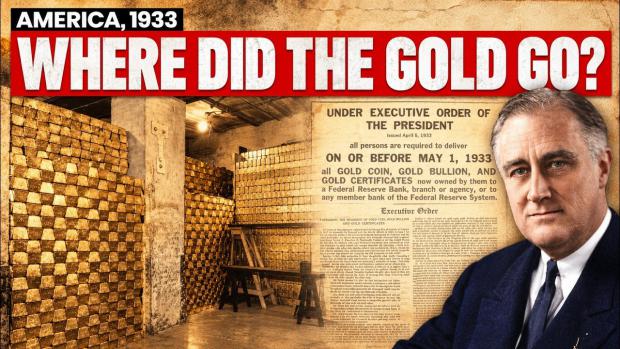
In 1933, President Franklin Delano Roosevelt did something no American president had done before. He made it a federal crime for ordinary citizens to own gold. Executive Order 6102 was signed on April 5, 1933, and overnight, the oldest form of wealth preservation in human history became contraband. Americans had less than one month to turn in every gold coin, every bar of bullion, and every gold certificate they owned, or face up to 10 years in federal prison and a $10,000 fine, roughly $240,000 in today's money. So what happened to all that gold? Who profited? And why did it take 41 years before Americans could legally own a gold coin again?
In this deep dive, we unpack one of the most audacious wealth transfers in modern American history. We trace the collapse of the banking system during the Great Depression, the bank runs of February and March 1933, the Emergency Banking Act, and the maneuvering that led to FDR's gold seizure. You will discover how the government bought gold from Americans at $20.67 per troy ounce, then revalued it to $35.00 just nine months later under the Gold Reserve Act of 1934, delivering a nearly $3 billion windfall to the United States Treasury at the expense of law-abiding savers.
We cover the little-known story of Frederick Barber Campbell, the 62-year-old Harvard-trained Manhattan attorney who became the government's "Gold Indictment No. 1" after he dared to sue Chase National Bank for the return of his own gold bullion. We walk through the 1935 Supreme Court showdown known as the Gold Clause Cases, where a 5 to 4 majority effectively told bondholders that yes, the government had broken its contracts, but no, they would receive no compensation.
You will also learn why Milton Friedman and Anna Schwartz estimated that only about 20 to 25 percent of privately held gold was ever surrendered, how Americans quietly ignored the order on a massive scale, and the strange tale of the 1933 Saint-Gaudens Double Eagle that later sold at auction in June 2021 for over $18.8 million.
Finally, we follow the long road to legalization: Nixon closing the gold window on August 15, 1971, Gerald Ford signing Public Law 93-373 in August 1974, and the quiet executive order that restored private gold ownership on December 31, 1974, ending the 41-year ban. We also look at what this episode means today for investors, savers, and anyone paying attention to inflation, the dollar, and the long arc of monetary policy.
This is the hidden history of American money. One signature, four decades of consequences, and a monetary system we are still living with today.