










Breaking News
 Kunstler: The 'Two Dan Sullivans' Case Exposes How 'Filthy' Democratic Party Tactics
 California High-Speed Rail CEO Resigns After Reporter Confronts Board Over...
 Appeals Court Rejects DOJ Request For California To Set Aside 20,000 Ballots
 Turning The Knife Inward: Xi Purges A Record 33 At Fifth Plenum As China's Military High Command
Top Tech News
 Microreactor Gets DOE Approval for Full Power Testing, Previously Contracts with Army...
 Ford Fathom: Everything We Know About The Sub-$30,000 Affordable EV Truck
 Love it or loathe it, AI is birthing a golden age of science
 SpaceX has no competition -- Saurav Shroff, Starpath
 Living computers forge a 'hive mind' and work together to outsmart AI
 The Faraday duffle bag: A digital lifeline in a surveillance-saturated world
 Delivery Robots Accused Of Scanning Customers' Faces, Sharing Biometric Data
 Brace Yourselves: Serious Trouble Brewing In The Data Center Industry
 FDA-Approval for Drill-Free Cavity Care May Be Imminent After Great Phase 3 Treatment Trial
 California Startup Says It Has Injected AI-Designed Virus Into Humans For First Time



RUSSIA'S NUCLEAR SIGNAL: A BULAVA MISSILE FIRED FROM BENEATH THE SEA OF OKHOTSK
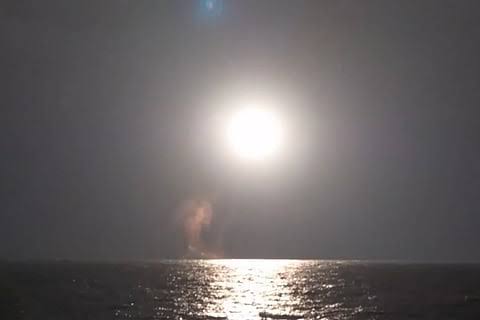
On 28 October 2026, Russia released footage of the Pacific Fleet's Generalissimus Suvorov, a Borei-A-class nuclear-powered ballistic missile submarine, launching an RSM-56 Bulava missile from beneath the Sea of Okhotsk.
According to Russia's Ministry of Defence, the missile's warheads reached the designated Chizha test range in the Arkhangelsk region, near the Kanin Peninsula. Russian authorities described the launch as part of the crew's scheduled combat training.
The reported trajectory covered approximately 5,500–6,000 kilometres across Russia a demonstration of the reach of Moscow's sea-based nuclear deterrent.
1?? A submarine is a survivable nuclear platform.
Unlike fixed land-based missile sites, ballistic missile submarines can operate while concealed underwater. Their ability to remain undetected makes them a critical component of a nuclear second-strike capability: the ability to retaliate even after an adversary's first strike.
2?? One submarine represents substantial firepower.
The Borei-A-class Generalissimus Suvorov can carry up to 16 Bulava submarine-launched ballistic missiles. The Bulava has an estimated maximum range of approximately 8,300 kilometres, according to the Center for Strategic and International Studies (CSIS).
The missile is designed to carry multiple independently targetable nuclear warheads. This does not mean that every missile carries its maximum possible warhead load in every deployment.
3?? Geography is part of the strategic message.
The Sea of Okhotsk lies in Russia's Far East, north of Japan. The designated test range is in northwestern Russia, demonstrating the ability to launch from the Pacific region towards a target thousands of kilometres away.
This is not simply about the missile. It is also about the survivability, readiness and reach of Russia's strategic nuclear forces.
4?? Routine training can still communicate strategic intent.
Russia says the launch followed its combat training plan. That explanation should be taken into account, rather than automatically treating the event as a direct threat or an imminent escalation.
Nevertheless, demonstrating that a submarine can launch a strategic missile from a submerged position sends a reminder of Russia's nuclear capabilities at a time of continuing tensions between Moscow and Western countries.
?? The important distinction: Russia has reported a successful test, but its claims about the warheads reaching the designated area have not been independently verified by the reporting cited below.