










Breaking News
 Cyberattack Hits European Supermarkets
 Watch LIVE: Alex Jones Has Discovered Why More Than 50 Governments Are In Emergency...
 Monstrous 13-foot mecha craves the dangerous jobs humans avoid
 Scentronic tech lets you smell the internet
Top Tech News
 PRP vs Exosomes vs Stem Cells: Which Fits Your Condition?
 SHOCKING: The Secret (Frantzve) Family Business
 Microreactor Gets DOE Approval for Full Power Testing, Previously Contracts with Army...
 Ford Fathom: Everything We Know About The Sub-$30,000 Affordable EV Truck
 Love it or loathe it, AI is birthing a golden age of science
 SpaceX has no competition -- Saurav Shroff, Starpath
 Living computers forge a 'hive mind' and work together to outsmart AI
 The Faraday duffle bag: A digital lifeline in a surveillance-saturated world
 Delivery Robots Accused Of Scanning Customers' Faces, Sharing Biometric Data
 FDA-Approval for Drill-Free Cavity Care May Be Imminent After Great Phase 3 Treatment Trial



For First Time In Years, Air Force Sends F-16s To Remote Aleutians, Near Russia
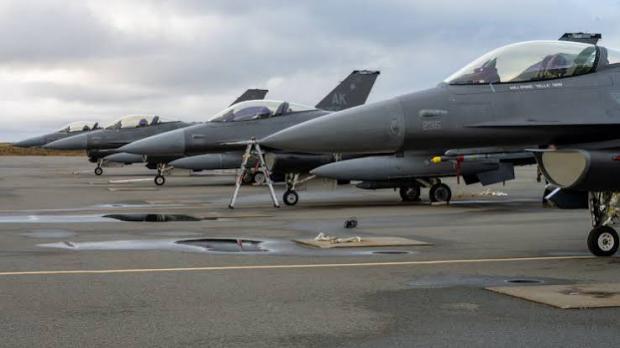
The deployment was notable as it was the first time in years that fighter jets were at Eareckson Air Station in an air defense alert role.
The use of the station on Shemya Island for this role comes as the U.S. looks to expand its abilities to rapidly move forces to remote or austere spots in the Arctic.
The F-16s were on Shemya, a tiny island sitting in the Bering Sea in the western part of the Aleutian Islands, as part of Operation Noble Defender, NORAD announced on Friday, Oct. 30. The operation, which started in mid-October and wrapped Oct. 26, saw American and Canadian fighter jets and refueling planes stage around Alaska and Alberta, Canada. It culminated on Oct. 25 with a large-scale air exercise called Operation Noble Eagle. It involved two F-16s, F-35 Lightning IIs assigned to Eielson Air Force Base, an E-3 Sentry from Joint Base Elmendorf-Richardson, Canadian fighter jets, and multiple refueling tankers.
As NORAD noted, Eareckson Air Station is roughly 1,600 miles away from Eielson. Air Force Lt. Gen. Robert D. Davis, the commander for the Alaskan NORAD Region, noted the need to "bring combat power together across vast distances."
"Operating from Eareckson Air Station proved we can deploy to an austere location, maintain alert, launch on short notice, and seamlessly integrate U.S. and Canadian forces to defend the northern approaches," Davis said in the NORAD announcement.
Shemya is home to a large runway as well as an important early warning tracking station. The island is closer to Russian territory than it is to the Alaskan mainland. During the Cold War it was home to many deployed fighter jets operating in air defense roles to deter the Soviets. In the early 1990s, however, Eareckson Air Station saw its regular fighter presence end. The military has returned aircraft to the station several times in the following years. As TWZ noted, special operations forces have repeatedly trained on the island in recent years in exercises focused on defending the important Cobra Dane radar system.
NORAD often scrambles fighter jets to intercept aircraft in the Alaskan Air Defense Identification Zone; the zone is part of international airspace but NORAD requires aircraft to identify themselves. Last year there were several instances of Russian jets entering the Alaskan ADIZ.
In its announcement, NORAD noted that the deployment to Eareckson Air Station further validated the remote base "as a viable location for future fighter operations from an austere airfield."